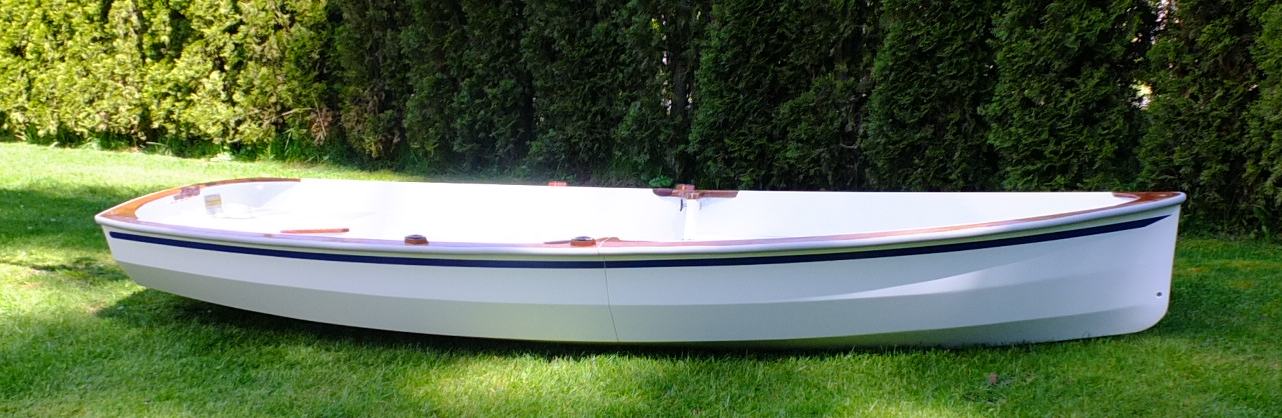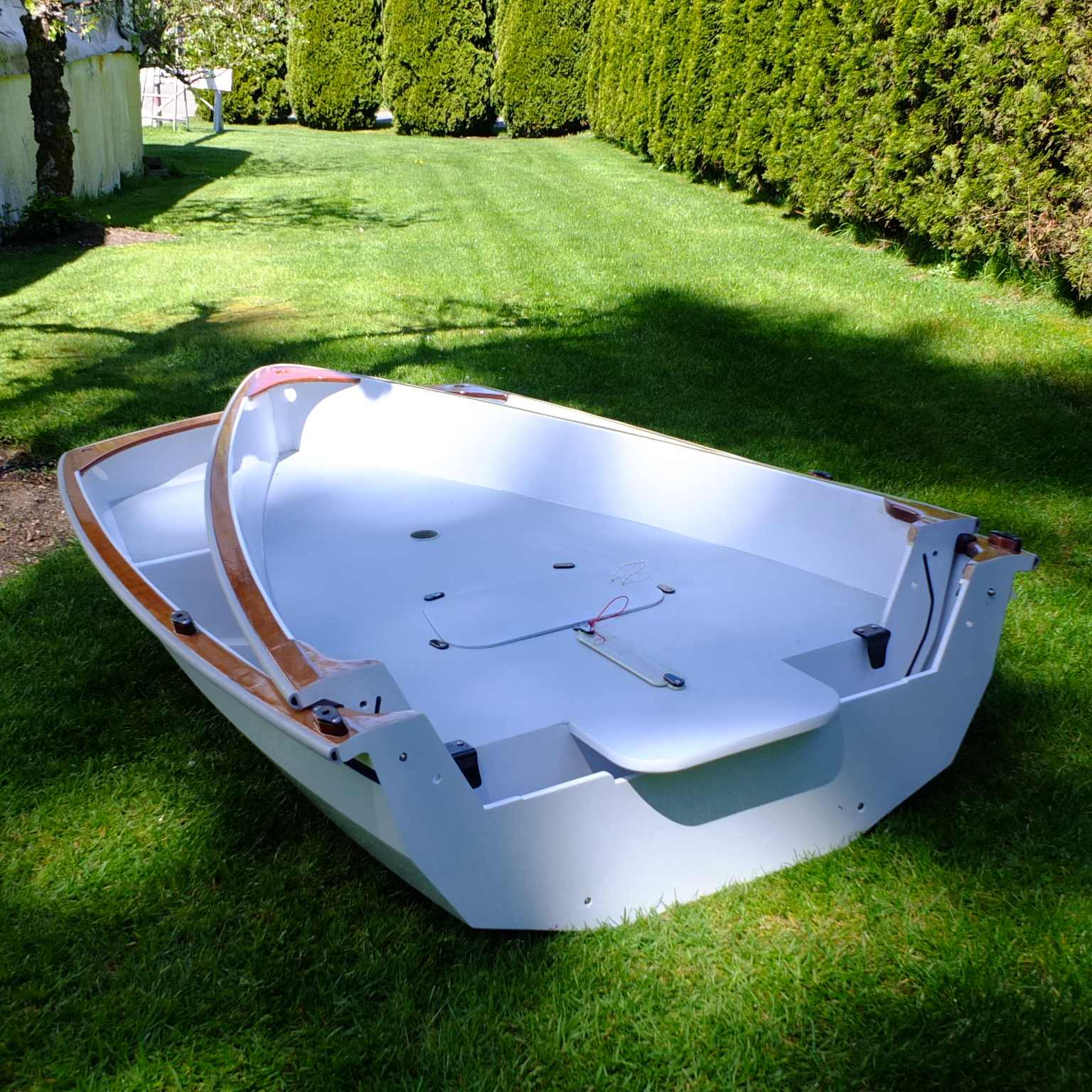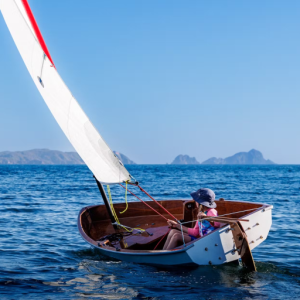
We now have a pattern for the PT 11/Spear cover. This option allows owners to pay their local canvas shop for time and materials to stitch it up but not for the time to measure and make a new pattern. Owners may also have the skills to stitch their own. The cover is for the PT 11 assembled to its full length or the PT Spear.
These photos show the first prototype cover that now belongs to PT Spear Hull #10. I regret not getting better photos with the poles installed to peak the center line but you can see one sent by a customer at the bottom of this post..
The pattern can be ordered here on our website. It gets shipped US MAIL rolled in a tube. The roll is 36" x 12 ft. long and includes general instructions.
Bow detailShown here with 18" dowels installed to raise the center line to shed water.
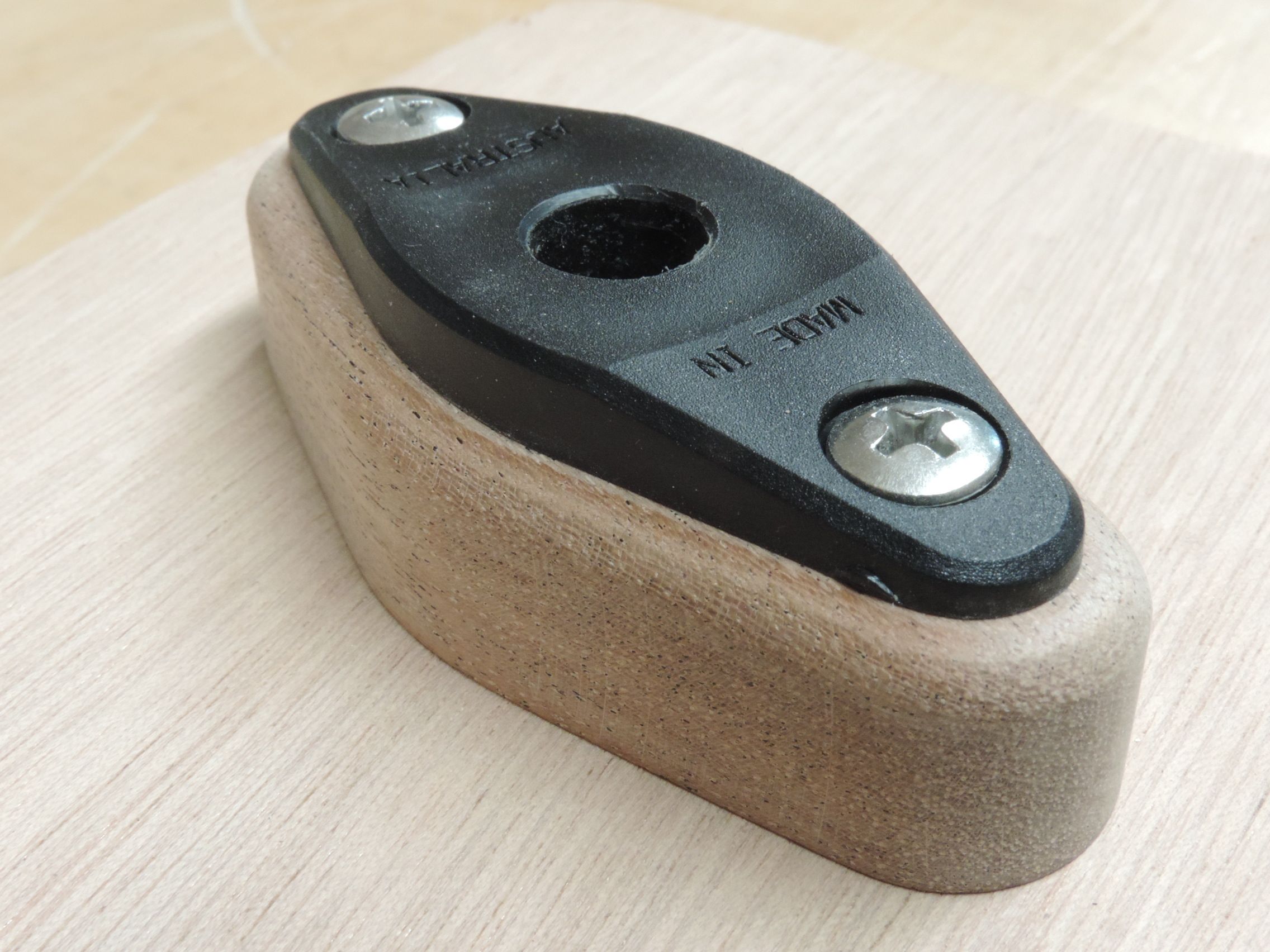
Our mahogany riser blocks of the past were beautiful complex shapes that performed a nicely functional duty; to give the oarlock socket more bearing and to offset the height of the seat relative to the height of the oarlocks. They were, however, rather beastly to make in the quantities we have been needing.
To improve production, Russell took the design to Turnpoint Design and figured out how, with minor changes, they could be machined on the CNC router. The remaining labor, (sanding out the tooling marks and rounding the upper edges ) is a great deal less time consuming than the previous version.
Comparison photo, new style left, previous version-right.
They are still made out of Sapele Mahogany. For those of you who wanted riser blocks this Fall when they were not available, this is our new product. Please let us know what you think. We have them IN STOCK! 😉 AEB
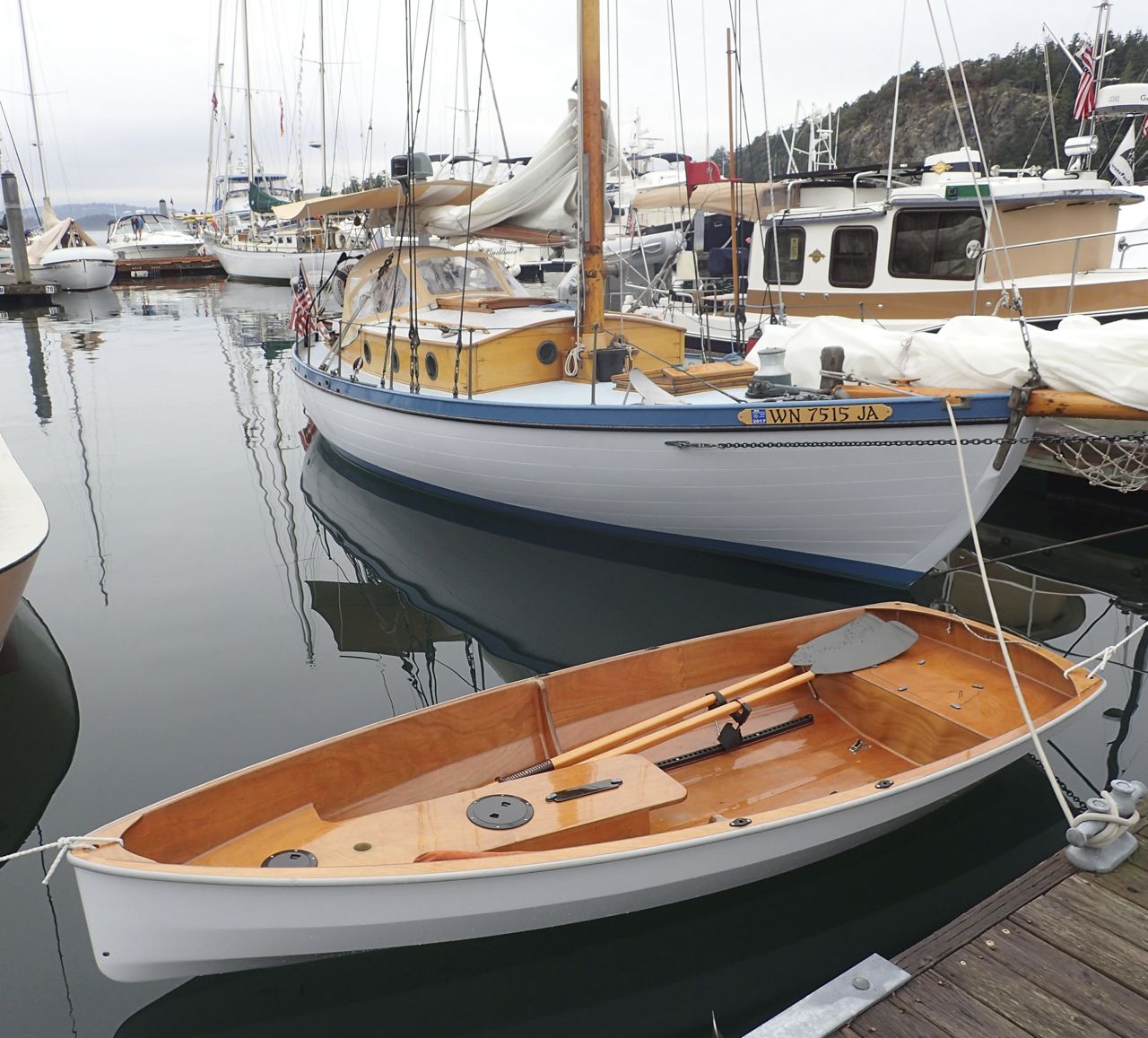
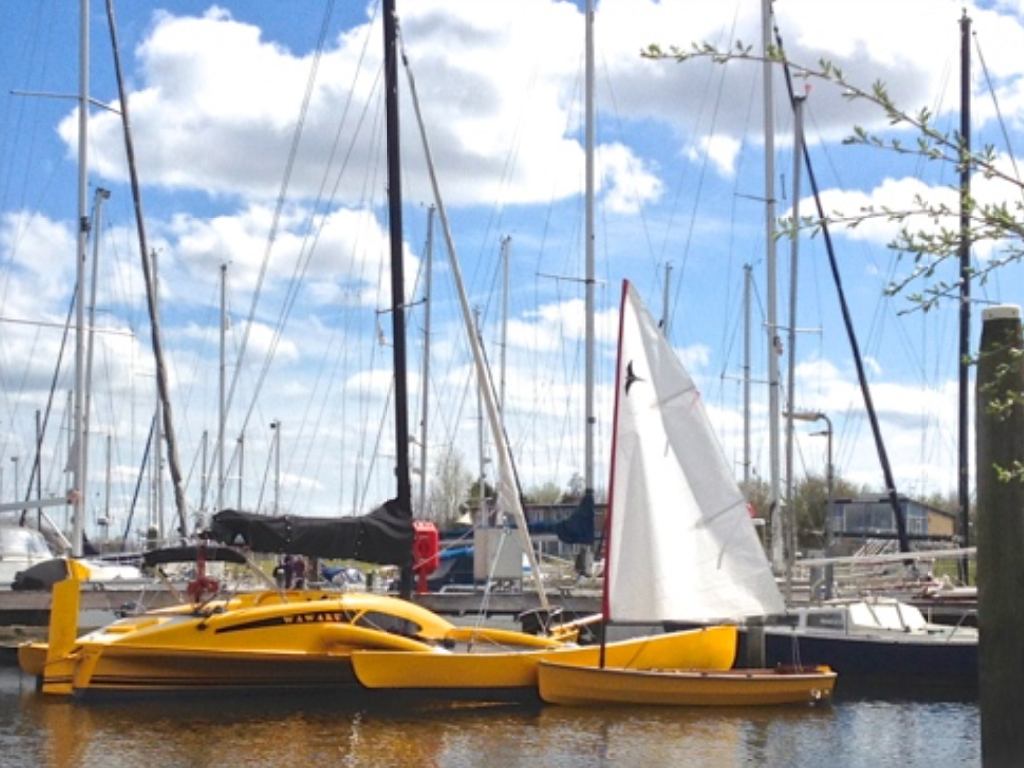
In August, we launched our “new” cruising boat, downsizing from Jzerro to a trailerable catamaran, unique in that genre, the Gougeon 32. We have managed to get away twice this year, on a shakedown trip to Deer Harbor and a week long trip into the San Juan’s after our local Boat Festival. On this last trip we took the PT 11, mounted on a custom made platform. I managed to miss getting a photo of it nested on its platform so we have to get that later.
Mary H is virtually opposite to the G32
We 'rendezvous'ed with 'Vito Dumas', our frequent sailing buddy, in Shallow Bay, Sucia. It turned into a stormy night but we still got in a good hike and a fun row. I snapped the above shot simply because I was struck by the interesting contrast of vessels. 'Mary H' is owned by a lovely couple, Lou and Al, who even offered to serve as a ‘dock’ when our anchor was not cooperating. Lou and Al are lifelong sailors only recently giving up their sailing home of decades, for more comfort without giving up mobility on the water.
Vito leaving Shallow Bay, Sucia
Russell and I do enjoy rowing around and exploring. Having Alex with us in his PT SPEAR, 'Pato', makes him our best model. He is both a great sailor and rower and I am ever grateful he has not fired this photographer for being such a pest. I cobbed together a short video of our week.
As the wind picked up the next day, we decided to move around to Ewing Cove.
A short run to the other side of Sucia...
We were able to pull the dinghy onto the platform without taking it apart, for the short runs.
The G32
After a day in Ewing Cove we sailed to Stuart Island into Prevost Harbor. 'Mary H' had moved there and Madam Pele, with Ian Andrewes showed up too. Ian was aboard the R2AK 2016 winner, Mad Dog Racing. Al Hughes on 'Mary H' was Captain on the 2015 R2AK winner Team Elsie Piddock. It felt like a small world, in a good way.
Vito Dumas and Da Capo in Reid Harbor, San Juans
From Prevost we moved to Reid Harbor. There Alex and I practiced our capsize drills. An effort was made to film all of this but the resulting video is mostly out of focus. A camera glitch...Bummer!
Lil' B, Pato, and Rascal
Scotty, on 'Da Capo' joined us in Reid Harbor. Now we had a PT 11 and 2 PT Spears in the fleet; Lil' B, Pato, and Rascal.
The next day we all had a good sail to Skull Island. (Orcas Island) There we enjoyed some sailing, rowing and hiking before heading back to Port Townsend. There was an impressive wooden, converted work boat crossing the straights with us. The view was beautiful. Photos follow. Video HERE.
AEB 😉
Click photos for larger view, then back tab to return.
View from the trail near Shallow Bay, Sucia
Rock formations on Sucia Island
Dramatic evening sky over Vito Dumas
A short run to the other side of Sucia…
Shallow draft is nice to have sometimes…
Our temporary heater…
Tidal rips and a good wind..
Vito Dumas and Da Capo in Reid Harbor, San Juans
Scotty taking an evening row at Skull Island
Beaitiful evening and Da Capo
friends and nice anchorages…
Crossing the Straights of Juan De Fuca
wooden converted work boat from Alaska headed for Port Townsend..
In the parking lot a Ferrier Tri lowers its mast one way while the G32 lowers the mast the other way.
This year was the 39th annual Victoria Classic Boat Festival. Among our friends who participated, Alex Spear was there with his beautiful boat, Vito Dumas and her tender, ‘Pato’, a PT SPEAR. 'Pato' is in fact the very first PT SPEAR.
In Alex’s words, ‘An esteemed panel of judges, including our local Carol Hasse, selected the PT 11/SPEAR as the “best open sailing vessel in the show”.'
This is a great honor. According to Alex, ‘Pato’ was not independently entered in the show but it garnered so much interest and attention from the judges that they deemed it worthy of mention. Our humble gratitude goes out to the judges.
Vito Dumas and tender, Pato, at the docks in Deer Harbor.
From Victoria, 'Vito Dumas', 'Sir Isaac', 'Sparkle' and other familiar and beautiful wooden boats converged at the Deer Harbor Wooden Boat Rendezvous.
Vito Dumas and ‘Pato’.
Below, Looking back on a rainy Deer Harbor.
Looking back on Deer Harbor as we head back to Port Townsend.
As beautiful as clear coated Okoume is, a couple of builder's have chosen to paint their dinghy interiors. They have also added non skid. I have to admit, I think these boats look super smart!
exterior paint job on Sadee Ann includes a nice racing stripe.Sadee Anne PT 11 nesting dinghy nestedSadee-Ann with painted interior and clear coated accents.A PT 11 in Holland with paint over non skid on the interiorThis PT 11 in Holland matches the 'mother ship'
When it was suggested by our local sail maker (NW SAILS & CANVAS) that we should come up with a distinctive insignia for the PT 11, I had to do some research. I looked at hundreds of existing insignias for sails. Some were really fancy, others were on the verge of pathetically bad, and others were very simple and yet, very effective. My goal was to create one that fit into the latter category. I had some pretty bad ideas along the way.. The Pacific Swift silhouette was a step in the right direction. From here I personalized it with the signature puzzle joint from our local CNC shop,(Turn Point Design) used in all of our kits in place of the traditional scarf joint. I showed it around to my 'honorary advisers' (as I generally do with most of my ideas) and I got positive feedback from lots of people. It stuck and.. is on all of our sails and much of our promotional materials. Below is the final insignia design for Port Townsend Watercraft's sailing dinghies. PTW
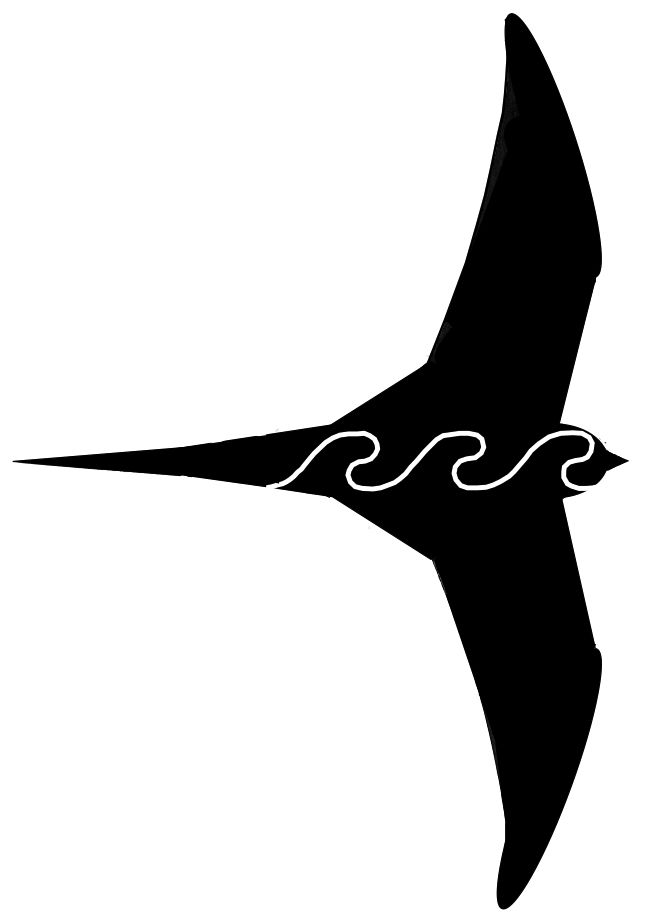
PT Watercraft's PT11 sail insignia is a Pacific Swift silhouette
Having a bailer in a dinghy is a very important thing. Dinghy sailing in gusty wind can get wet, especially if the captain is not paying attention and dips the rail. Russell came up with a handy bailer idea. This oblong fabric softener bottle offers both a wide mouth scoop and a low profile that fits neatly below the seat tongue. Stashed inside for minor spray is a sponge. This green sponge was a waste of pennies. It does little more than spread spray water. A good absorbent sponge like this PVA sponge or 3M C41 7456-T is a much better choice. I personally like these pop-up sponges but they do not hold up well if left outside, which is kind of the point environmentally.. 😉 This bailer installation does not interfere with nesting. There is room to spare. We used carbon glue on eyestraps and a bungee cord to keep the bailer stored out of the way but within quick reach.
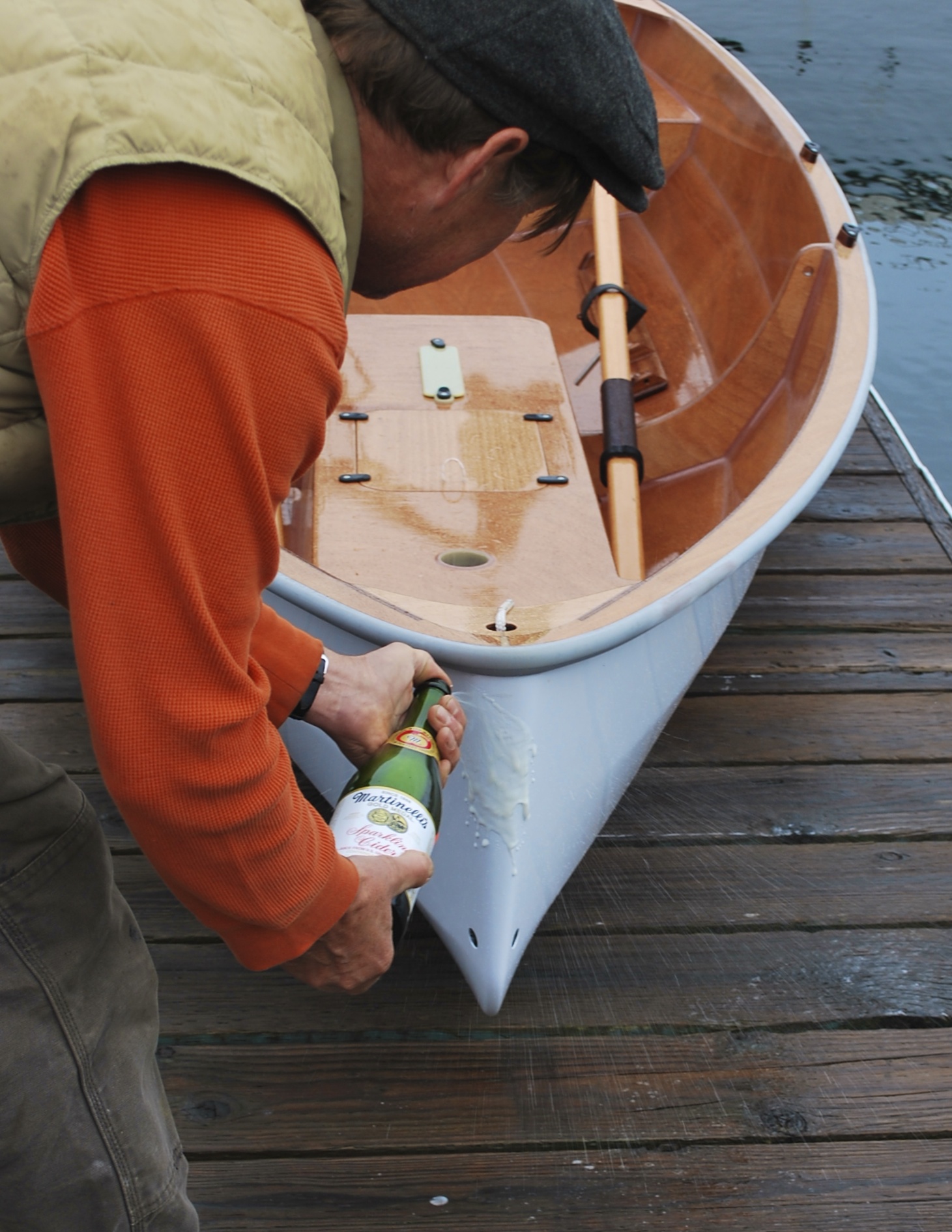
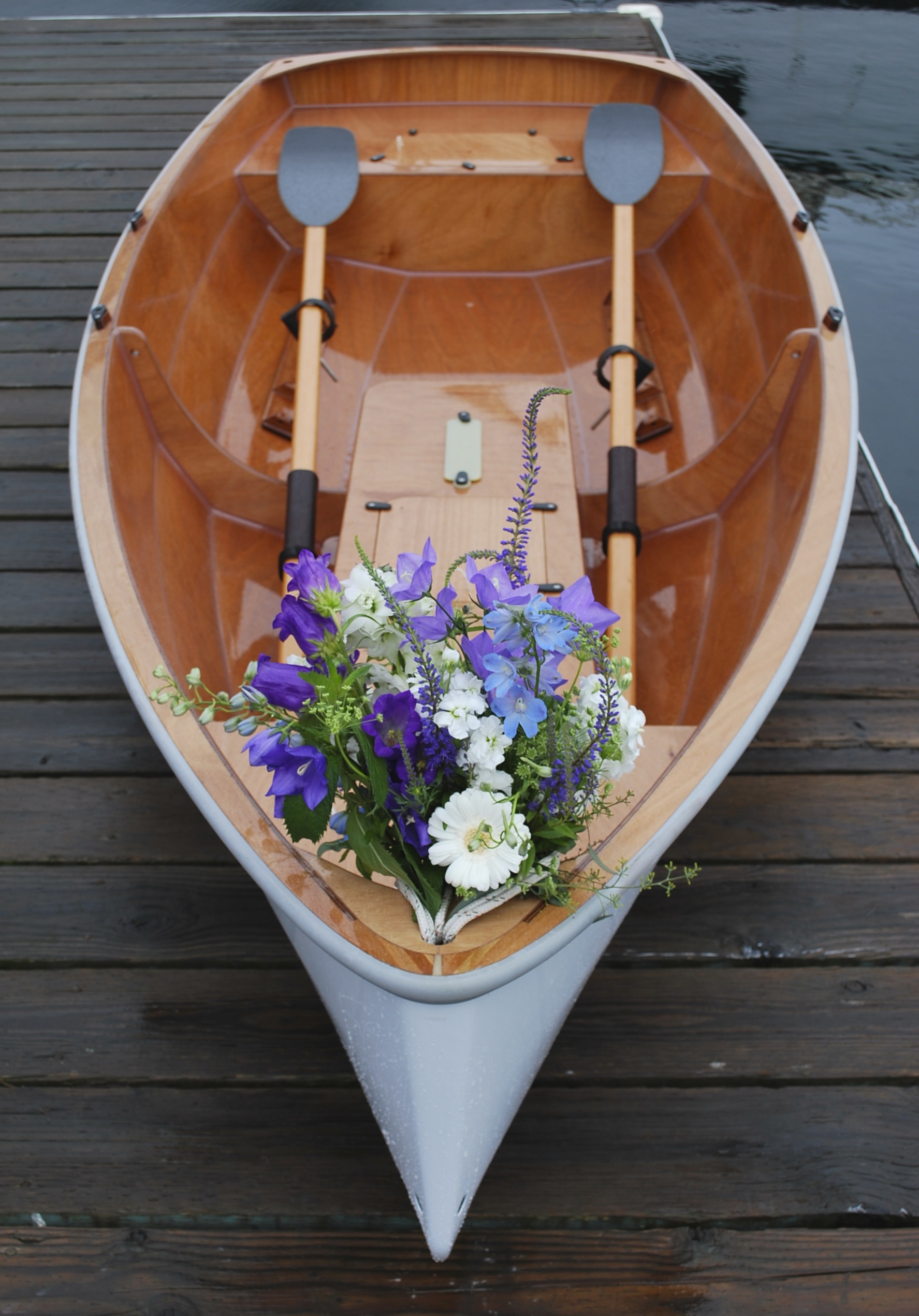
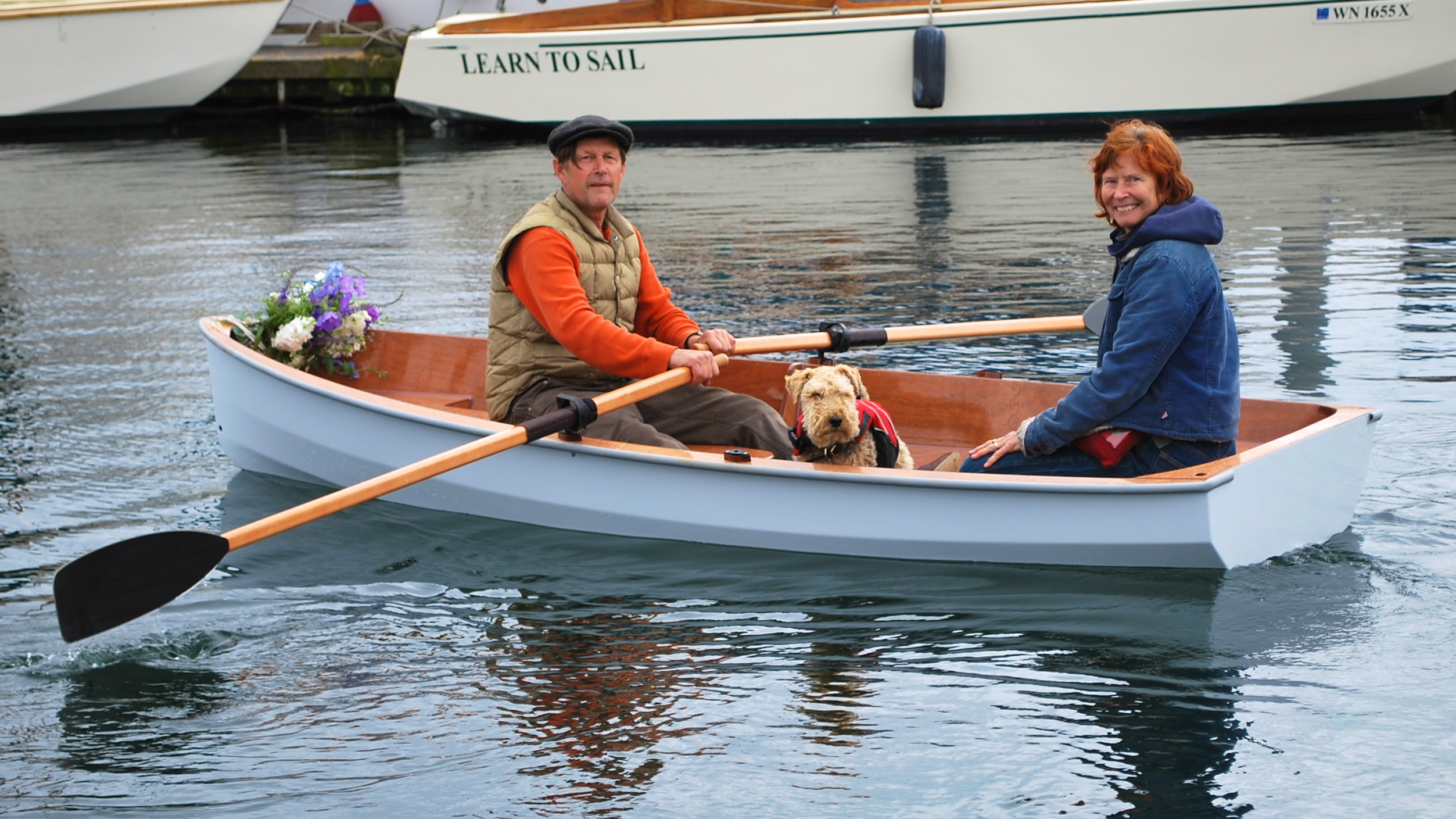
The PT Spear, one piece PT11 design is now official and kits available. This was such a Port Townsend moment; A dinghy launching with flowers and bubbly, great friends and even a blush causing speech in the drizzling rain. All that was missing were the bagpipes!
A Port Townsend dinghy launchingChristened 'RASCAL'
THE SPEAR is identical in hull shape to the PT 11, but the interior geometry and construction are quite different and deserve explanation. The PT 11 has a full width foredeck so that water drains into the aft compartment, otherwise there would be three areas that would need bailing of rain and spray. The Spear can have scuppers through the main bulkhead (the nesting PT 11 can’t) and therefore can have what I call a “trunk” seat.
When rowing with three, the trunk seat allows more comfortable seating for the person sitting in the bow. The areas to the sides of the seat are good for holding oars and other things in the boat.
The trunk seat also keeps the hull from twisting under sailing loads. It’s like a torsion box. (Shown below are the PT11, left, and the beta prototype of the Spear)
Below photo taken in March 2013 of the prototype being built to figure out the process and to write the manual.
Two of the watertight hatch kits that we offer as options fit really well in this boat, making the boat versatile for carrying (and keeping dry) groceries, camping gear, cameras, safety gear, etc.
The aft hatch is easier to access when sailing and is great for things like cameras, jackets, and food, but because of the baffles under the back seat (more on that next), the volume of area under the forward hatch is much greater.
While the hatches are work to install, the cost of the kits is very small compared to the utility and safety they offer. They also provide access and visibility to the daggerboard trunk, mast socket, and rudder hardware, not to mention a good place to hide valuables left in the dinghy. Coast Guard regulations play a large role in the interior geometry of the PT 11 and the Spear. This may sound like big brother getting in the way of art, but it’s quite the opposite. The regulations are to protect us, the kit provider and especially you, the end user.
Buoyancy built into the right parts of the boat is necessary for safety. Sealed air voids (compartments) have the same value as flotation foam, but access ports or hatches are not allowed in sealed air voids. If the builder insists on inspection ports, it is then necessary to fill these voids completely with foam flotation in order to comply with safety standards. The Below Photo shows the boat before the deck and back seat lid are installed. The bow area (forward of the mast step bulkhead) is a sealed air void in the PT 11 and the Spear. The PT 11 has built in buoyancy tanks in the back of the boat on either side (outboard) that are equal to the volume in the bow. This is what the Coast Guard wants, and it makes sense.
The Spear has a large back seat area, but because it has a hatch, we have to install baffles to form sealed air voids outboard of the hatch where they would do the most good in an emergency. Though the baffles under the back seat decrease the usable volume for storage, they make us legal and make you safer, and they make for a well supported back seat. Below; Rowing the Spear with 2
The finished boat pictured was a beta prototype built summer 2012. Due to less specialty hardware required, the Spear base kit will cost several hundred dollars less that the nesting version. The boat will be lighter by 3 - 5 pounds. The various options, including sailing rig, offered for the PT11 nesting dinghy will be the same for the Spear. As of April 2013, we are taking orders for the "SPEAR" kit.