Growing Pains

Things have come a long way since we first started producing kits. We have put a lot of effort into making production more efficient and timely. The current kits contain parts that require less fitting and fiddling. We have refined the kit, and the manual.
One thing we have maintained is the stance that a really good nesting dinghy is a complex boat and the PT 11 is a really good nesting dinghy. In order to offer it as a kit that even an amateur can build, we have had to take the idea of ‘kit’ to a new level. Some have asked why  our kits are more expensive than the average kit boat of comparable size. Others who have bought and built our kits have said that we do not charge nearly enough.  Their praise has been high for the content, instructions, accuracy, attention to detail, and overall quality of the kit and resulting boat. While kits are not exactly flying out the door in mass quantities and we are not getting rich, we are not complaining. We stand by our custom products and personalized service, and we feel that we have a special family of PT11 and PT Skiff owners, who have expressed great pleasure in both building and using their boats.
ptwatercraft.com
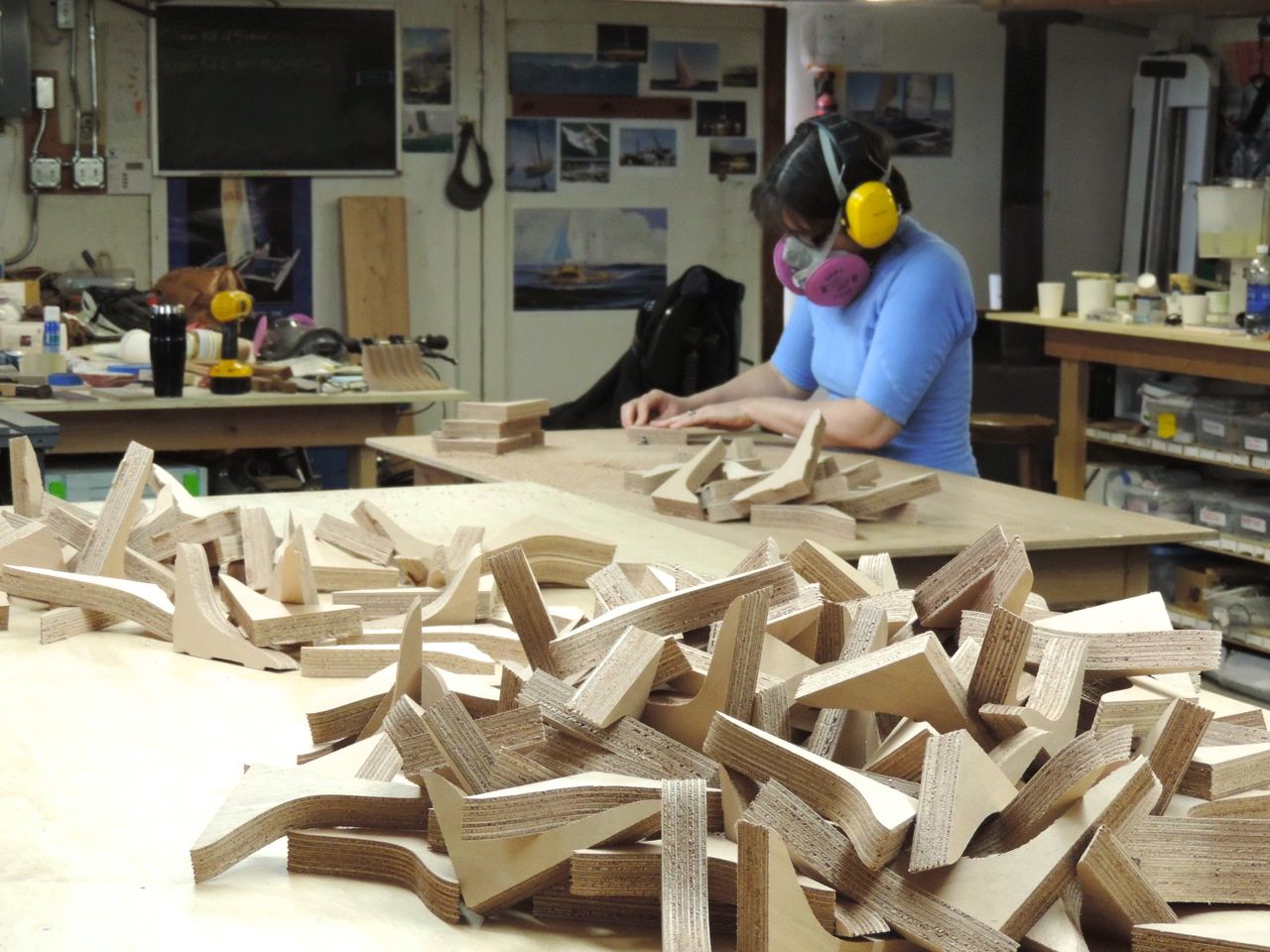
-cutting apart and pre-routering gussets for the PT 11

Not all feedback is praise....

...given the fact that we have forgotten to pack a part on occasion. This featured comment, in all it’s sarcastic humor, is a prime example...

"I found a small glitch in your packing.  Nothing major: the installation of the dagger board cover calls for two washers (under the dogs, I think).  Without them the dogs are too low with the gasket in place....  Through an outrageous and abject failure in your quality control, none were included.  😉
I know I can source nylon washers locally, even though that will put me far over budget.  I thought I'd touch base and ask about specs: is there anything special other than serving as a spacer and friction control for these washers?  Are any of the dimensions particularly important?  Are you going to spank Russell? " J.W. June 2014.

On the flip side, builders take heed..

“man’s best friend” has been known to find kit parts to be yummy chew toys. Keeping parts in your crate with the lid on until needed keeps out both excess dust and curious ‘Fido’. I know it is nice to have company in the shop but there are lots of bite sized bits in our kits. We use a detailed packing list when filling the crates and if we checked it off, we put it in. (granted, sleep deprivation can interfere from time to time..) In most cases, we will replace lost pieces free of charge so do let us know if it just cannot be found..(along with a photo of your orderly shop space!...just kidding... 😉 Seriously though, there are a lot of small parts in our kits that need to be kept together in a safe container and we  know of at least one 5 axis shaped inner stem that was definitely lost to the shop dog.

The PT 11 is known as a “nesting dinghy” and while many people know what that means, many again, do not. It is easy to explain that the boat can be separated into two parts, and the bow half ‘nests’ in the aft half, making it possible to own a relatively large dinghy that will store in a relatively small space, such as, on the deck of your boat. I had assumed that the term “nesting dinghy” referred to exactly that.  In our circle of boats and dinghies, it does, but is it the right  term?

ptwatercraft.com
Not everyone gets it right away..

The internet provides lots of definitions that all begin with the base word NEST. My 4” thick Random House Dictionary of the English Language defines “nest” in the 9th definition as,”to fit or place one within another”... Or the 12th: “ to fit together or within another or one another..” This definition works until I get asked if it means that one or more of our dinghies stack well. The fact that the dinghy comes apart into two ‘nestable’ parts, is left out of the equation.  The word “nesting” is not even in this big dictionary. It is online and I kind of like this one lonley meaning for the word even if it is related only in an abstract manner ;
nesting
— adj, nesting  (ˈnɛstɪŋ)
 — n
the tendency to arrange one's immediate surroundings, such as a work station, to create a place where one feels secure, comfortable, or in control.

I have also had people ask me about our “nester”.  Looking up the definitions for this was interesting. In my big old dictionary,  “Nestor” is the wisest and oldest of the Greeks in the Trojan War. In the urban dictionary online however, see this screen shot:

urban dictionary definition of 'nestor'

But that is nestor with “or” and I usually get “nester” with “er”.  “Nester”  is not in my dictionary but it is online and not exactly fitting. Look at the urban dictionary definition too. This was new to me! You can be sure I will refrain from casually using the word “nester” when talking about our beautiful dinghy. 😉

internet screenshot
internet screenshot

Urban definition:

urban definition of 'nester'

I think, after this belated study on this terminology when related to the PT 11, we can settle on something closer to the following: The PT Eleven is an 11 ft,  two part dinghy with nestable parts that store in a 6ft by 4ft 2 inch by 20 inch space.

You probably know where to find more info on our PT Eleven nestable dinghy kit and if not, click HERE.

Have you seen our Youtube channel?

Thank you for following! PTW 😉
More NEST definitions. (I deleted the bird and insect references...)
nest
noun
...
4.
a snug retreat or refuge; resting place; home.
5.
an assemblage of things lying or set close together, as a series of boxes or trays, that fit within each other: a nest of tables.

verb (used with object)
8.
to settle or place (something) in or as if in a nest: to nest dishes in straw.
9.
to fit or place one within another: to nest boxes for more compact storage.
verb (used without object)
...
11.
to settle in or as if in a nest.
12.
to fit together or within another or one another: bowls that nest easily for storage.
...
Origin:
before 900; Middle English, Old English  (cognate with Dutch, German nest;  akin to Latin nīdus  nest, Old Irish net, Welsh nyth, Sanskrit nīḍa  lair) ≪ Indo-European *nizdo-  bird's nest, equivalent to *ni  down (see nether) + *zd-,  variant of *sd-,  ablaut variant of *sed-,  v. base meaning “sit” (see sit) + *-o-  theme vowel

Related forms
nest·a·ble, adjective
nest·er, noun
nest·like, adjective
nest·y, adjective
Dictionary.com Unabridged
Based on the Random House Dictionary, © Random House, Inc. 2014.

We recently finished our sixth (yes, sixth) PT 11 prototype. This was to incorporate a few design changes and re-write much of the manual in an effort to make the boat easier to build. Building this many boats can lead to some labor saving ideas and we felt that we needed to do our best to make this, “kind-of-high-tech” boat as easy to build as possible.

In the last related blog post we detailed some of the changes we have made to the boat. Everything worked well, the new manual is done, and kit parts are stacked to the ceiling and ready to fly out the door.

ptwatercraft.com
transom inwhale with bow notch allows for a more snugly nested package.

ptwatercraft.comRelevant details even if you already have a PT11;
We have a few new details to share. Most are in the new manual but could be useful for people that already have PT 11’s.
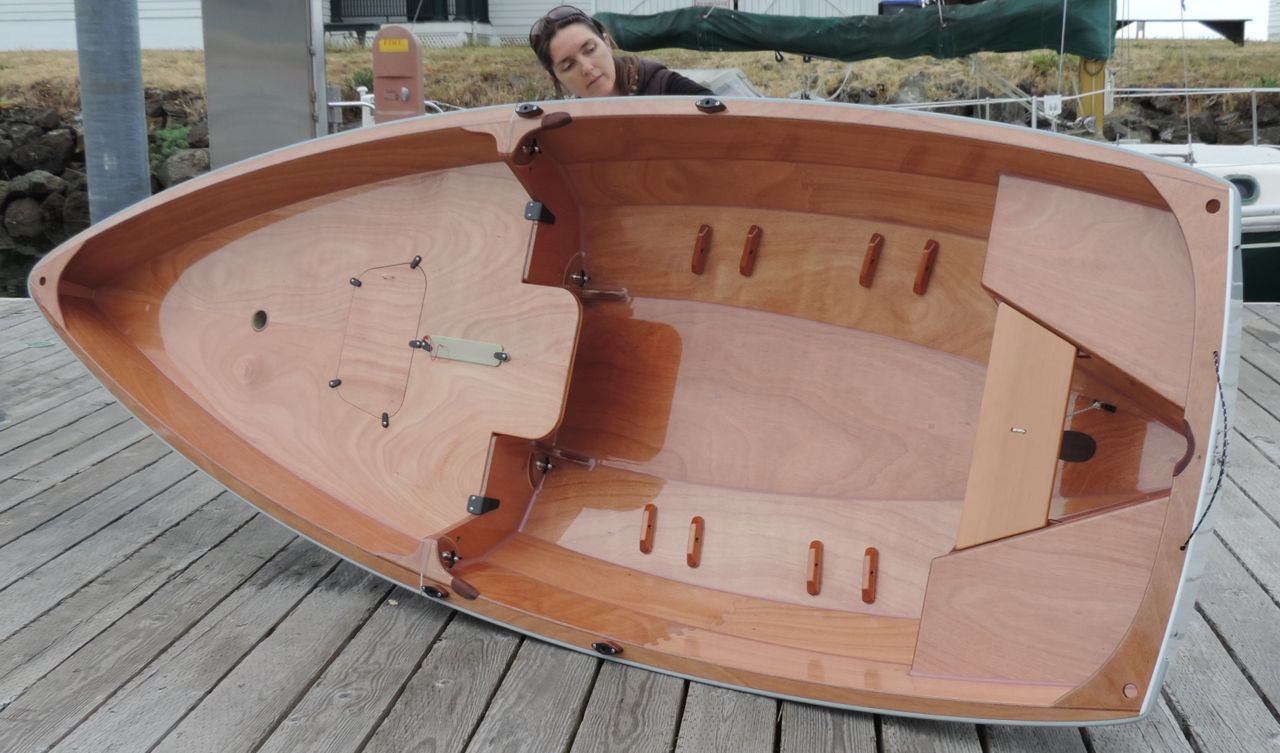
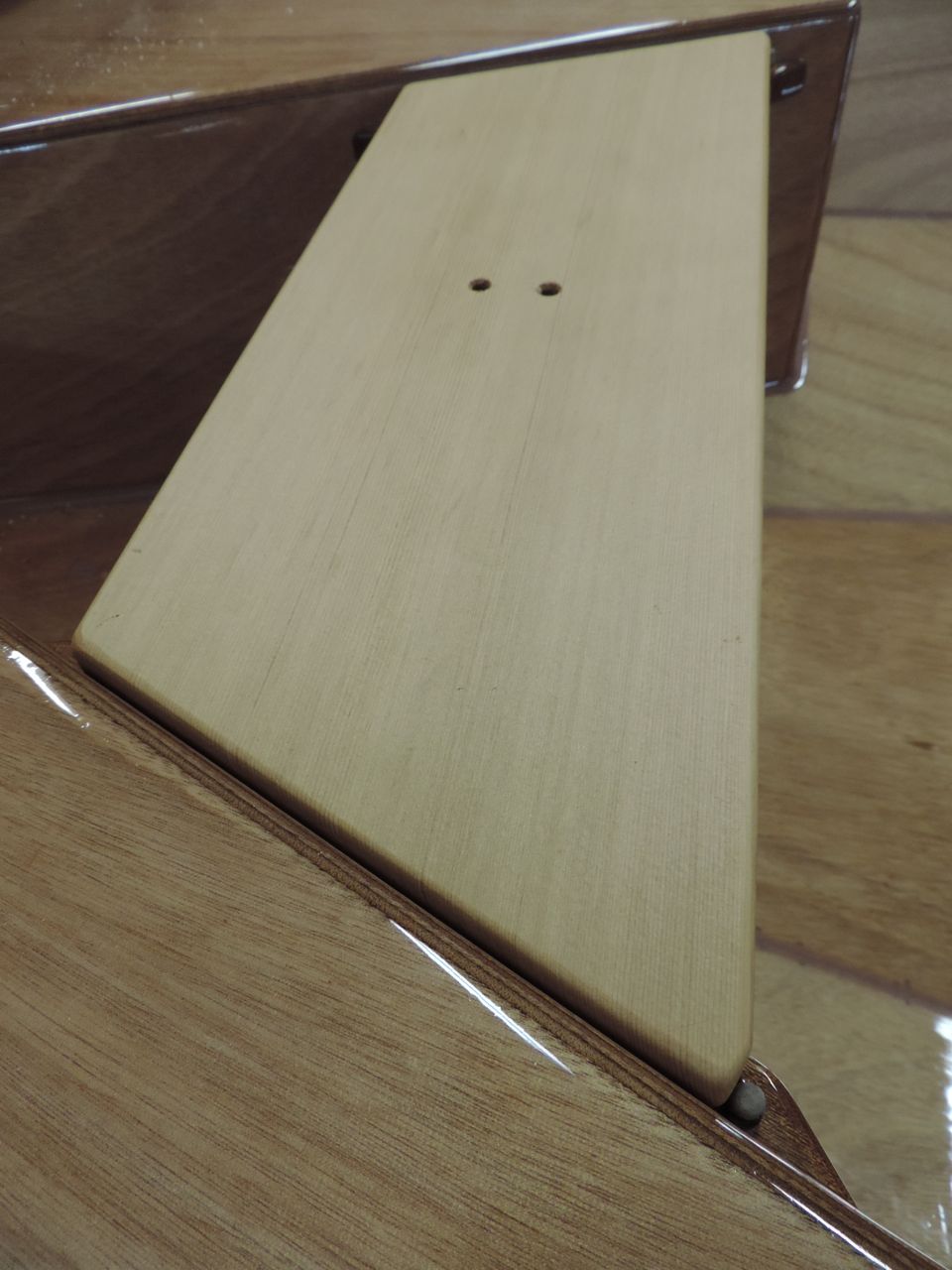
The back seat had two issues: One is that the seat needed a way to be held against the tank wall when nesting the boat. For some reason we never realized that if we trimmed 1/4” off of the aft edge of the seat (it’s now 7” wide), it could wedge between the cleat and the shock chord knot as shown below. It’s secure enough not to fall over when nesting the boat and that’s all it needs.

ptwatercraft.com
seat wedges neatly when ready to store the boat nested.

The other issue is that the back seat could slide forward, (even with the bunji cord) come off the cleats, and drop you on your butt.
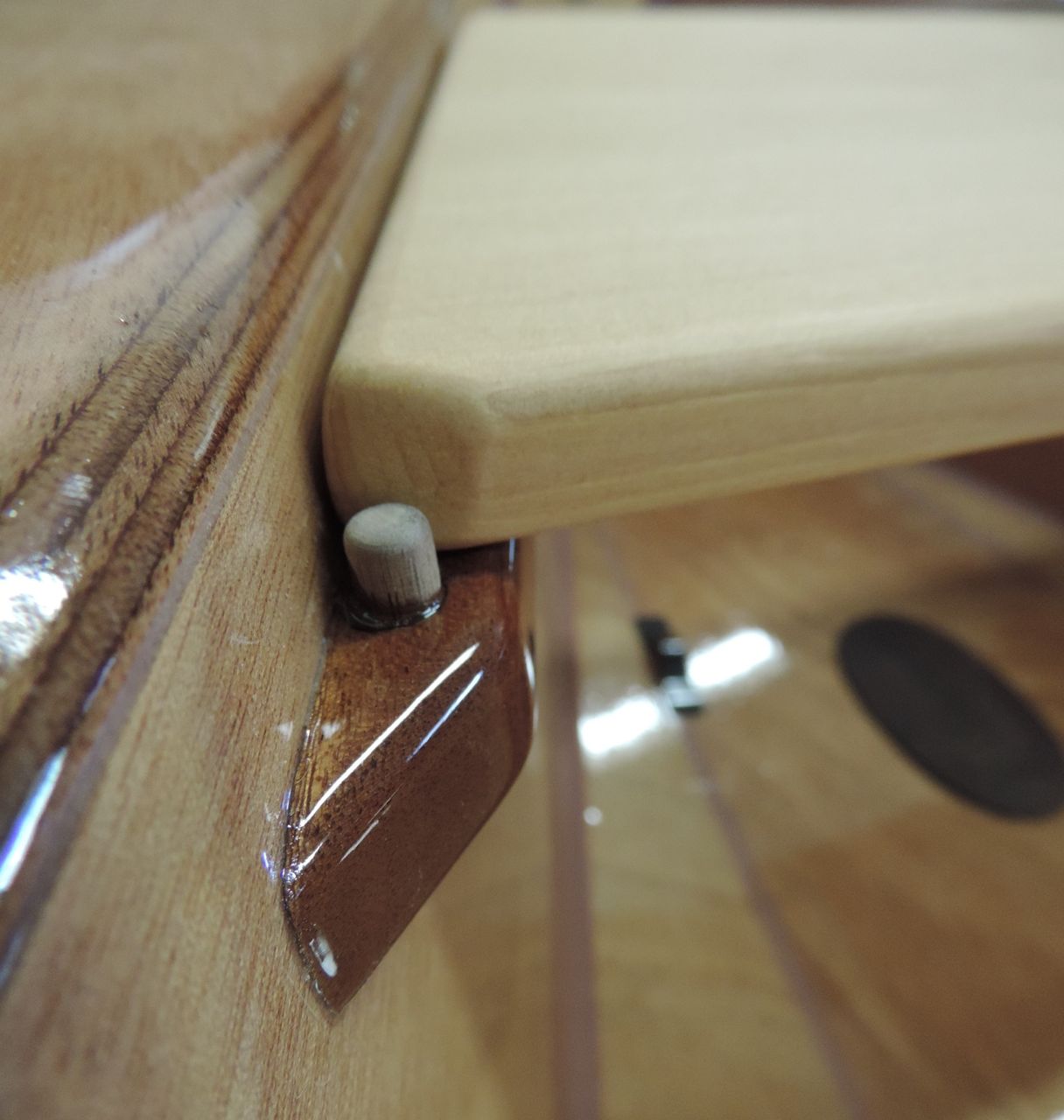
The fix is pretty simple. We trimmed a bit from the outboard edges of the seat with a sanding block (to move the seat aft) and we block sanded the forward corners of the seat as shown, all so that there was enough cleat showing to drill holes in. We then drilled 1/4” holes to a depth of 3/8” for the 5/8” long hardwood dowels to glue into.
This works well, it’s an easy fix, and if you already have a boat, we can send the dowels to you along with the handy-dandy tether washer we shown below.

ptwatercraft.com
See the dowel stopper in the bottom right corner of the photo.
ptwatercraft.com
The back seat dowel stopper prevents the seat from slipping forward.


ptwatercraft.com
Custom machined Delrin (TM) washers with tether loop.

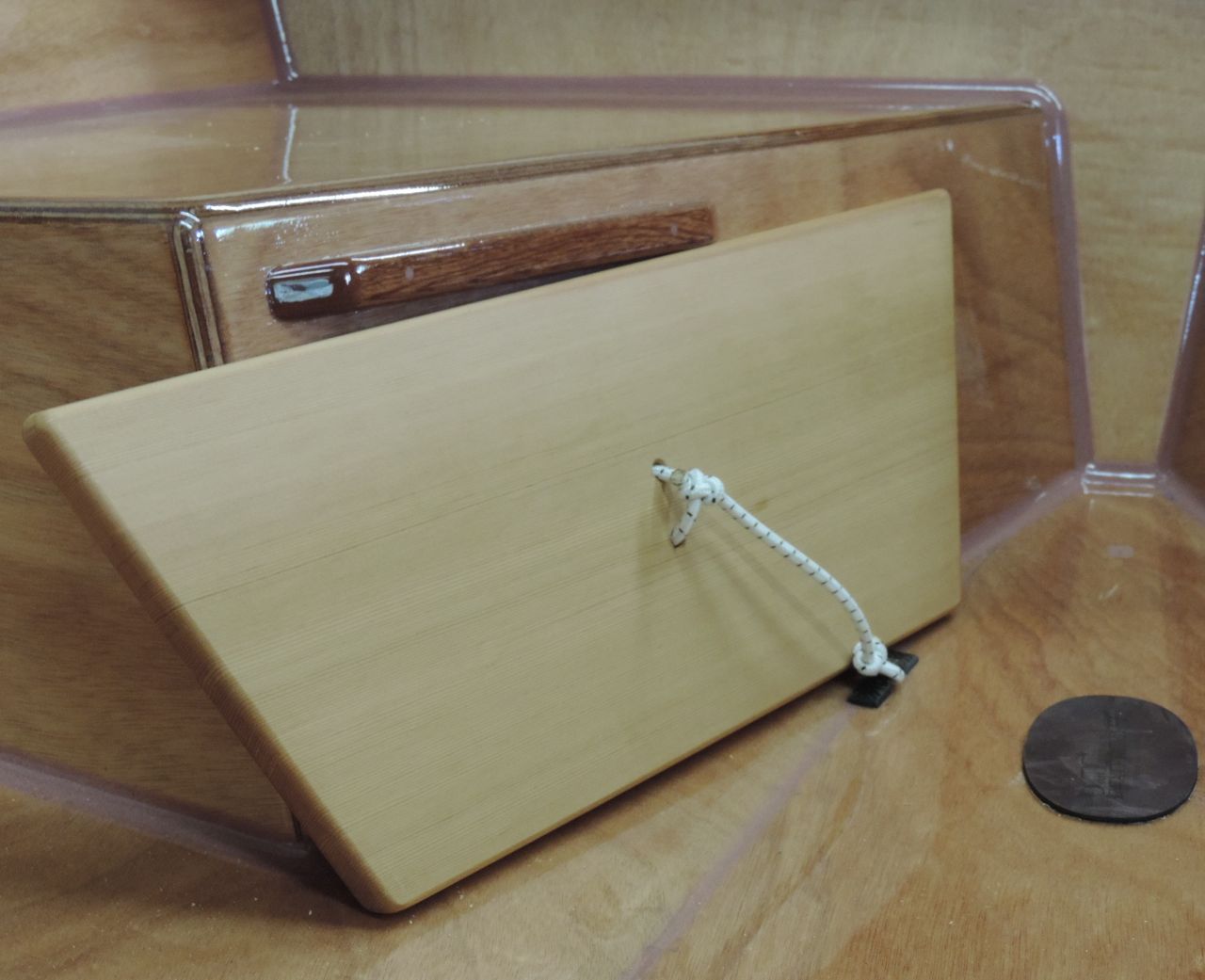
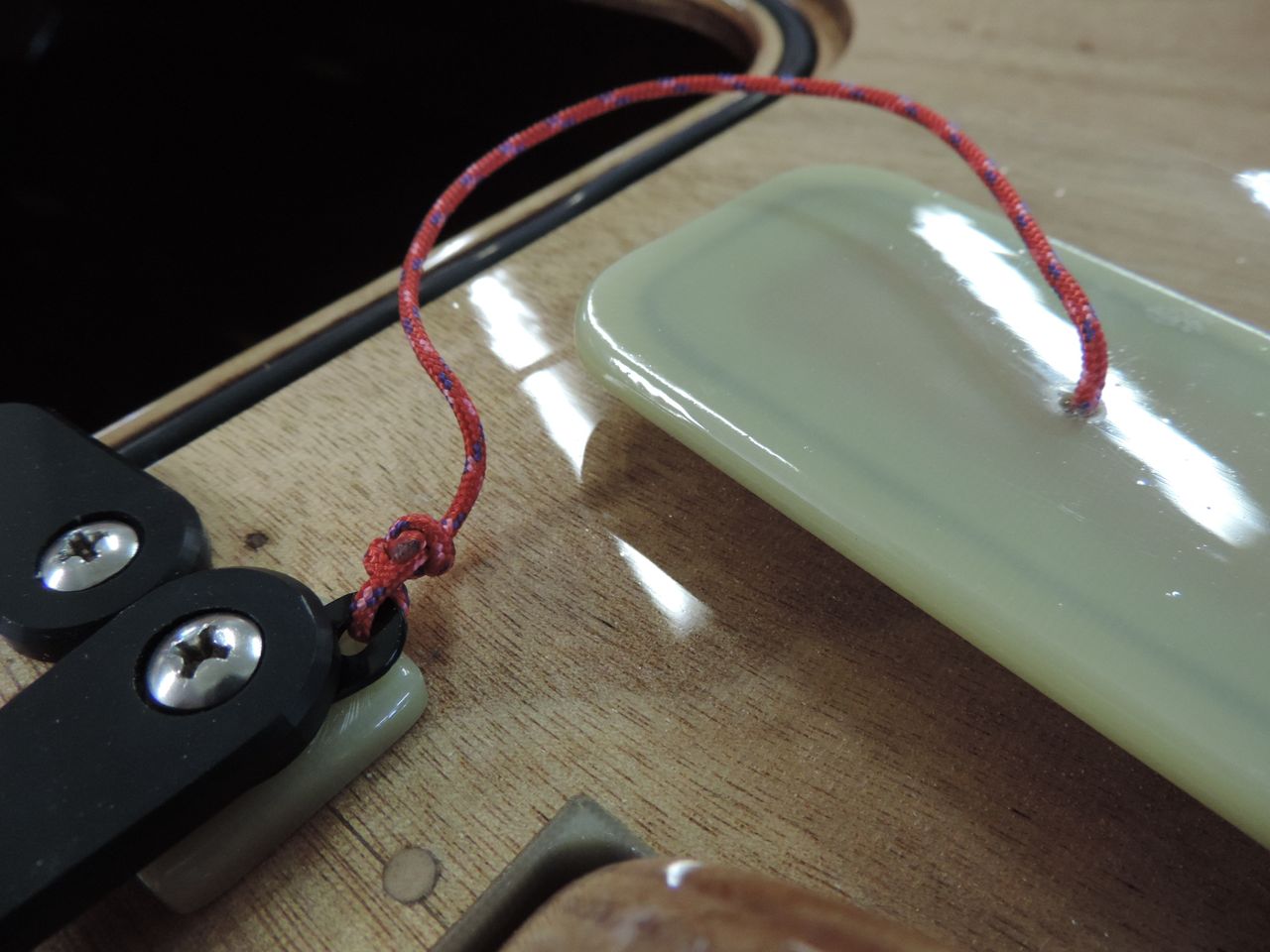
We have always kept our dagger-board trunk cap in the forward compartment, but it can be hard to find in there if it’s full of stuff. It’s easy to glue a tether into a hole drilled in the cap, but where to tie the tether? To the washer under the forward turn dog, that’s where.
It’s a special washer made for us by a neighbor who laser cuts other parts for us as well. This is a thin Delrin(TM) part, but we had a very hard time breaking one.
Replace the round washer with this one and rotate the washer aft for fishing the tether through the hole.

ptwatercraft.com
PT 11 dagger-board trunk cap with tether.

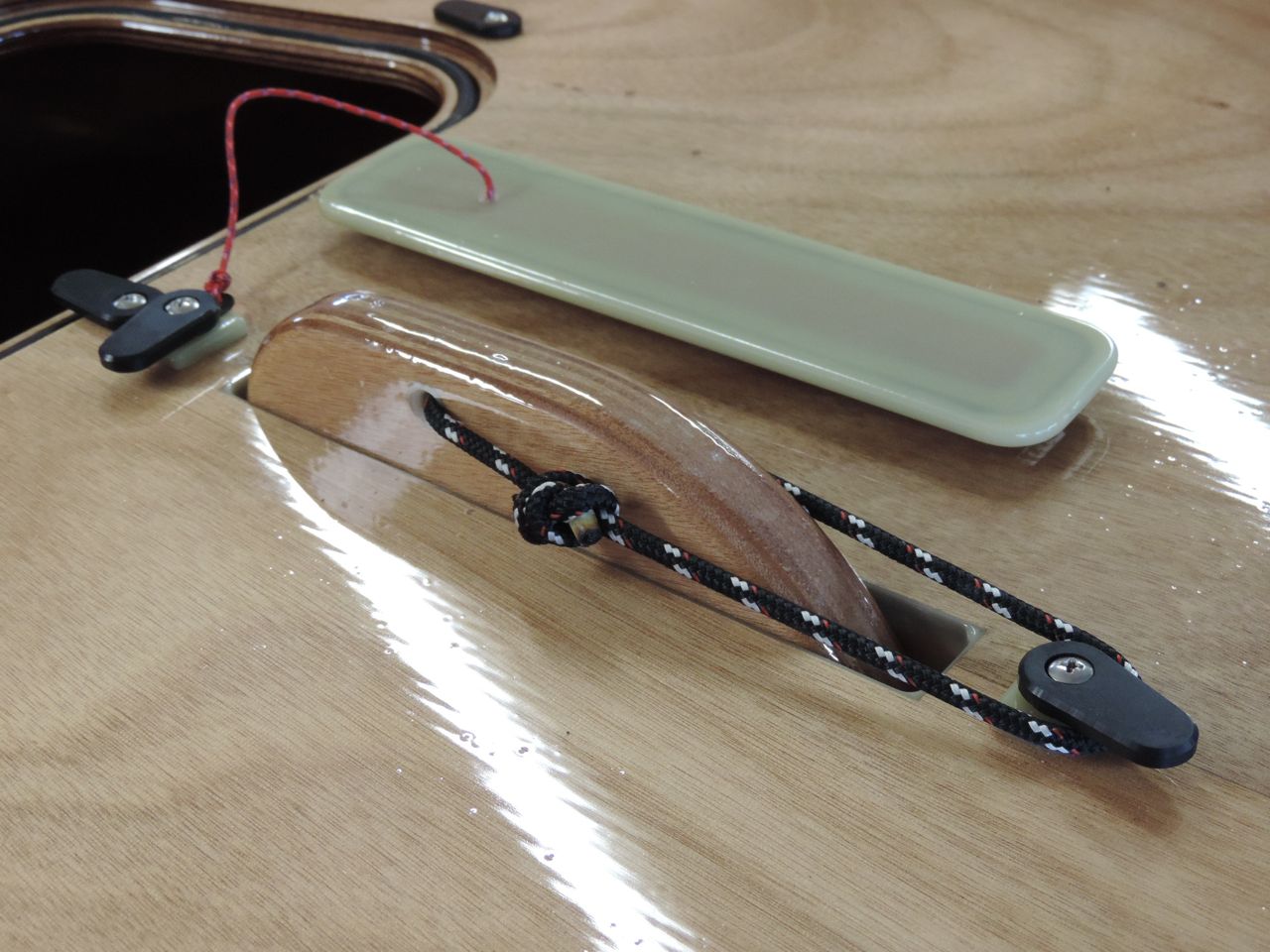
Holding the dagger-board down has always been done with a rope loop that can hook over the aft turn dog, but having the loop fairly snug (as shown below) keeps the board down all the way.

ptwatercraft.com
Having the loop the right length keeps the board down all the way.

Having the board down fully will make the boat climb like a 12 meter when sailing upwind and it will also help you run aground. No, what I meant is that it will help if you run aground.

ptwatercraft.com
-showing the dagger-board fully down at the underside of the trunk.

We hit a rock very hard and not only did it nearly throw us out of the boat, but the sharp trailing edge of the board hit the aft end of the trunk (because the board was up about four inches) and did a small amount of damage to the trunk. The dagger-board was fine, but we now sail with the dagger-board down all the way or we unhook it and let it float up (about a third of the way).

RB PTW

Since we began producing the PT 11 kit, all of our costs have gone up. Plywood, CNC machining, and everything else we use has increased in price.
For now, we are holding the price of the basic kit where it has been since we began but we need to increase the prices for the rigs and foil kits.

Our sailing rigs are getting both better and lighter.  These rigs are not a kit. They are ready to drop in the boat and go sailing. All the spars and some of the fittings are carbon fiber, the hardware is Harken, and the sails are beautifully made out of top materials. The unfortunate fact is that they are also more expensive for us to produce than when we began.  (Clicking on the photos below will lead to detailed posts, in new frames, about the rig and foils kit.)

ptwatercraft.com

Our foils take a surprising amount of materials, CNC time, and handwork.  Like everything we produce, these parts are clean, efficient, and nice to look at. Not your average kit dinghy foils...

ptwatercraft.com
Click on Photo to see a full post about our foils kit.

See our website for new prices. Thank you! PTW 😉

Work on a slightly re-designed PT 11 and a much improved building manual for the 11 is well underway.
We have long been planning to develop a smaller version of our nesting dinghy, but for several reasons, we decided to focus our efforts on making the PT 11 as good (and as easy to build) as we can make it.
One reason for this decision is that we are a small company with no employees (just ourselves) and even though the design process for the smaller boat was well underway, the thought of needing to stock all the parts necessary for a smaller boat seemed like too much.
Very few of the parts for the bigger boat would fit the smaller one. Even the rig and foils would need to be different, so the PT 9.5 has been put aside... For now.

The PT 11 has been a constant evolution. I have built so many prototypes and modified the manual so many times that I have lost count, but we love the boat and it has become quite a popular kit.ptwatercraft.com

The new changes in the boat (and the manual) are mostly aimed at making the boat easier to build.
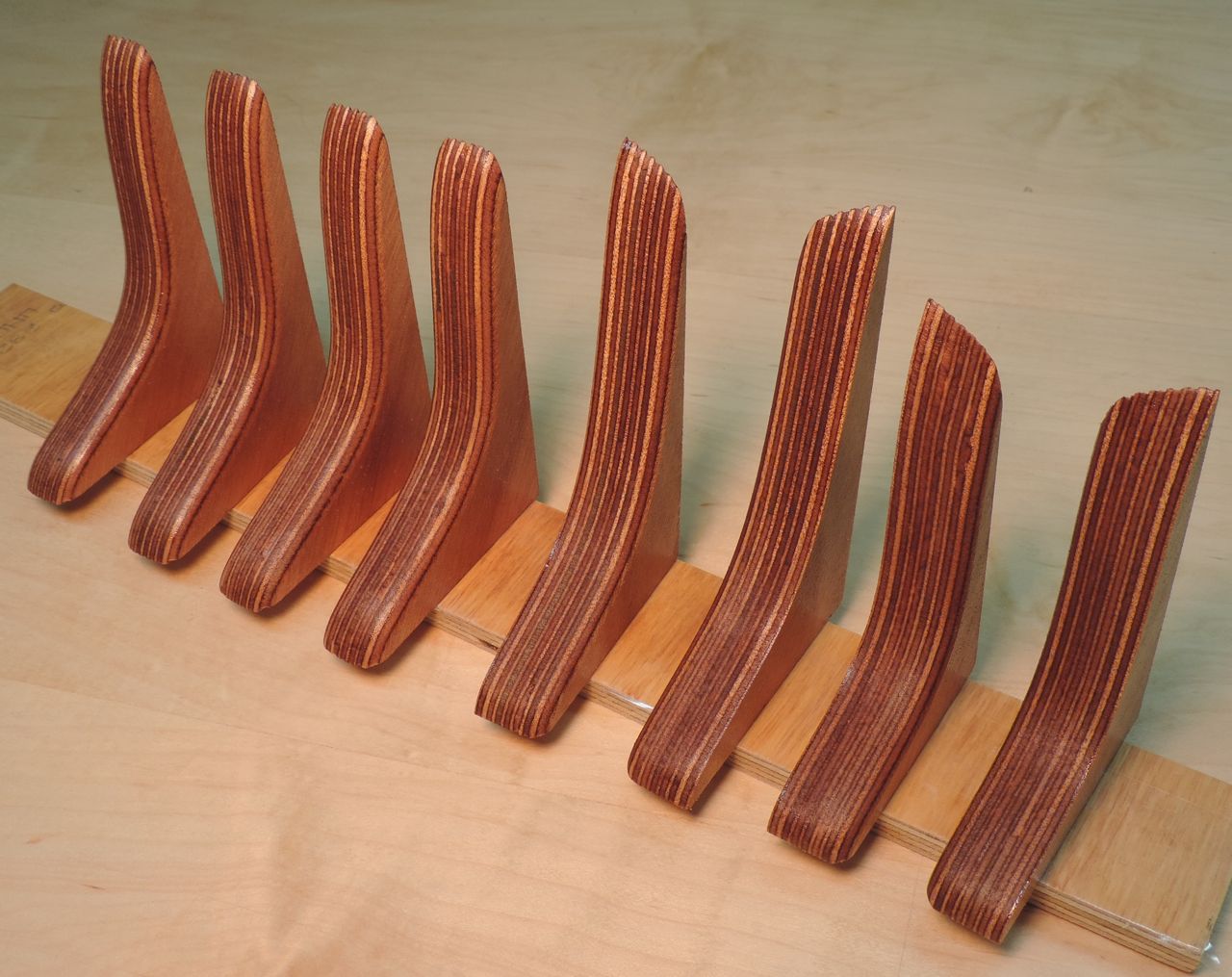
The biggest change is to make the gussets both thicker and slightly larger so that the builder can avoid the tricky job of applying the structural fiberglass over the gussets, besides making sense structurally.ptwatercraft.com
The gussets will now be pre-beveled so that the upper gussets fit the hull without the builder having to do it and the curved gusset edges will be pre-rounded so that builders without router tables can avoid the risk of rounding their finger tips.
We wanted to make the two halves of the boat key together more snugly when nested, so the transom inwale is now wider and has a reinforced notch cut into it that the stem fits into when nested.
That, along with the larger gussets will mean that the forward half will just fit into the aft half, and once it’s there it won’t be able to move.
We will have the new boat cut in half soon to check our tolerances and then machine new gussets and inwales for future kit orders.

In the manual we are changing many parts of the process, mostly just to clarify parts of the process with more photos and better text, but some parts, such as the process of fiberglass taping the chines has been changed to a much better method, one we have used on the last couple of prototypes.
We have also been working on a video of some of the more challenging parts of the process. This video will (eventually) include filleting, chine taping, glassing, gloss coating, and painting.

PTW

Multihull enthusiasts may know that designer Dick Newick passed away last year. Among his things were a stack of posters of his amazing, and historically significant, proa, "Cheers", as painted by artist Bruce Alderson. One of these posters has graced our walls for many years and we are pleased to be able to offer them at a special price. Please read more about "Project Cheers" HERE.

ptwatercraft.com

Initially, we have set the price for the USA  as postage is easily assessed.

For Europe, we would prefer to send several posters to a distributor.  Individual postage from here to Europe, runs at $24 for the cheapest method. We hope that by having a distributor in France, postage will be far less.

Interested persons from outside of the USA should contact me to get on the list. Anyone interested in buying several for resale should contact me. QUANTITIES AT THIS PRICE ARE LIMITED.

Please note that a portion of the proceeds for these posters will go to Mr. Newick's widow. In addition, there are a limited number of posters signed and numbered (253-294/400) by painter, Bruce Alderson.  We are also in the process of re-publishing the book, PROJECT CHEERS.  Please see our webpage for details.

'cheers!' PTW

As of Monday, April 7 th, our PT 11 nesting dinghy will be on display at Fisheries Supply in Seattle. This is something we have talked about doing for a long time and we are pleased it is happening this year. Fisheries Supply is one of our very favorite resources.

On display is our PT 11 that we have used a lot for 3 seasons now, around Port Townsend and north into Desolation Sound, BC.  We have done a lot of exploring in this boat, some of which is featured in our videos. The interior finish is still the original WEST SYSTEM EPOXY(R) clear finish using 207 Special Clear Hardener(R) done in 2011.  It is due a coat of varnish but I think you will be impressed at how little the scratches show even after all the sand and shoes.   So if you are in the area, please stop by FISHERIES SUPPLY and check the boat out! Let us know you stopped by.  THANK YOU! ptwatercraft.comptwatercraft.comptwatercraft.comptwatercraft.com

ptwatercraft.com
Loaded with gear commuting to our boat's mooring, before taking off for Canada.

More boats are getting wet this year. I am really enjoying everyone's news.

Olav in Victoria BC launched his PT 11 earlier this year. I like the below photos in particular. If you had to choose a dinghy to be proud of for your beautiful cruising boat, would it be like those in the back ground? Or more like the sleek hull in the fore ground??  Beautiful job Olav!  😉

ptwatercraft.com PTwatercraft.com

James in Australia launched his PT 11 this winter (summer ,'down under') with his son. I received these pictures in January. Again, a great job on the boat!! ptwatercraft.com ptwatercraft.com

BLUE WHALE ADVENTURES is headed into the Pacific with a PT 11 that was recently built by Cape Fear Yachtworks. Fair winds and happy adventures!

It sure is fun when folks get colorful. This sunny yellow PT 11 is sure to turn heads for Gregg in California! I continue to be impressed with beautiful workmanship. I may be able to publish more photos soon as the weather warms and folks get out on the water.ptwatercraft.com

Is your PT 11 or PT Skiff in the water? I would love to feature it next. 😉 PTW

We recently had the opportunity to test drive a Lehr outboard on the PT 11 nesting dinghy. http://golehr.com/lehr-marine/
I should say up front, that we are personally anti-outboard for this boat. The PT 11 is lightweight with a hull shape well suited for easy, near effortless rowing, even for longer distances. The sailing rig is also very easy to use. Our vision has been that this dinghy can be a tough, utilitarian, and totally enjoyable alternative to inflatables, as tenders for cruising boats.  Even so, the PT 11 can be used with a small outboard.  We have calculated that a 2HP outboard would be plenty of power to move this little boat with ease and also keeps the PT 11 within a certain USCG category.

In our opinion, however; those who expect to use a motor on their dinghy more often than not, might be better off with a different dinghy. One could choose a boat with a fuller aft end. Rowing performance would be compromised but these boats would plane with a 5HP motor.
There are, it seems, few, new model outboards of 2HP or less.  Most outboard producers currently have models of just over 2HP. Other than the perceived "need for speed" from the general public, we are not sure why they have chosen to discontinue lower HP motors. See a PT 11 test drive with an EP CARRY.
For the sake of experiment and because this motor was offered to us for this purpose, we went ahead and made a test drive.  Thank you to J.S. for this opportunity.
Here is what we found and there is a link to a short video at the the end of this post.

I. Motor: New Lehr 2.5HP propane outboard. ( 15” shaft, cost: roughly $1050)
Port Townsend Watercraft
II. Weight: We feel like this motor is quite heavy at almost 39 LBS(incl small 1 LB gas bottle)

III. Noise: Moderate.

  • Comparison:
  • On forums online, the Honda 2.3 has been proclaimed as very noisy.
  • Electric motors are obviously the most quiet.

IV. Speed: The Lehr 2.5 propelled the PT 11 with a single, 180 pound operator, at 6.8 knots, at full throttle in protected waters.

  • No comparisons at this time.

V. Trim: The PT 11 is light weight. The weight of the motor being nearly half the weight of the boat, and with a single operator having to sit far enough aft to reach the tiller, causes the bow to ride high. One would need a tiller extension to be able to shift driver weight forward.

Port Townsend Watercraft
Taking off at full throttle..

VI. Mounting: The outboard was mounted with a raw mahogany block just below the inwhale. For the purpose of this demo, we adhered it with double sided tape. For more permanent installation, we would advise exchanging the bolts on the top gudgeon, for screws that bite into the block. On the outside of the transom, we used raw mahogany strips. The block and pads are to prevent crushing or denting the hull skins when tightening the clamps.  For a motor this heavy, we recommend re enforcing the transom with vertical ribs adhering to the buoyancy tank walls and butting up to the underside of the inwhale. This would be light and effective. Port Twnsend Watercraft

Port Townsend Watercraft

VII. Conclusion: In general, if you are set on mounting a motor on the PT 11, it is preferable to choose a motor that weighs less than 30 LBS. We will be making some effort to mount and test drive the Electric Paddle in 2014.
Click here to see a short video of the PT 11 with the Lehr 2.5HP.   PTW 😉

Note: If any of our builders have tried a small outboard on your PT 11, please contact us with your experiences.

UPDATE: This information was sent to us from one of our builders in Florida. The HP used exceeds sanctioned HP for this boat but the results are informative.

"Today's Sea Trial:  Salt water, 75 degrees, sea level, iPhone GPS.

POWER:  2.5 HP (rpm restrictor removed to increase to 3.3 hp), 1990 vintage two stroke, factory propeller, 27 pounds, Mercury outboard with tiller extension.

Life jackets, paddle, no additional gear.

Top speed, one 140 pound operator, 10 mph.  
Top speed, two people 330 pounds, 8 mph.
Top speed, four people 810 pounds, 6 mph.

Ideal cruise "sweet spot", two people, 6 mph.

Boat exceeded all expectations. " (Video below)


More PT Watercraft boats are hitting the water! Here are some to spotlight;

Simon and "crew" happy after launching in New Zealand.  I quote Simon, "I didn't really realize how much of a delight to build she's been until the bumper had been stuck on and I was a little disappointed that there wasn't anything left to do except go sailing."

The blog for this build is great. Simon took wonderful photos of his progress. Check it out HERE.

PT 11 nesting dinghy in New Zealand ttMelody_cityscape

I really like the red on the PT 11! Great choice of color!ttMelody_scootin

Garland has finished his PT Skiff in Virginia! The first one to be built on the East Coast and the first with self bailing installed. Congratulations!  Looking very classy! garland's skiff

While taking his time to build the boat, he wrote, "“The other thing that delays me is I enjoy it too much! And it relaxes me. I stand back and admire the quality of the wood, and how things look. Once it takes shape, I'll admire how  the flat panels pull together to make the graceful curves.”IMG_1096_1 IMG_1099_2Garland says.."we launched Sunday, and carried a real load! Five adults and two dogs. Considering the load, we did well. I was prepared for the boat to be tender, and she was, but not bad."

Not everyone has a camera handy, even in the age of fancy phones. I still want to congratulate James in Olympia on his launching of his PT 11 this year.  I am looking forward to pictures! See his blog with some construction photos HERE. Awesome glosscoat!

Wouldn't it be fun to have a fleet of dinghies and skiffs at the Port Townsend Wooden Boat Festival in 2014??!!   My thanks to everyone for doing such lovely work on their boats. These kits are very detail oriented and our growing family of builders appears to be putting heart and soul into their projects and I must say, it makes us feel really good! Thank you! 😉 PTW