About

PT Watercraft designs dinghies that are efficient, functional, modern, and attractive—available as kits you can build yourself. We also carry small boat parts and instructional books.

Quick Links

Connect

Explore

By Category

By Date

Category: Inside PTW Clear

Winter season update

A bit of snow in Port Townsend and things slow down a lot and, like so many, we too saw some record low temps for this area. For Christmas Eve we are back to wind and rain and all is green again around our house, the Salal and conifers having shed their blanket of white. Christmas treePC210791

We wish everyone a safe and warm Winter holiday season and a bright New Year. We are super grateful to everyone building the PT 11 and all of the good folks who participate in the production of our kits, who offer our books, and all who have shared their enthusiasm and friendship. The PT 11 has played a key role in expanding our circle of interesting and valued relationships. As a business, it hardly gets better than that.

Did you see Leo’s look at choosing a dinghy featuring the PT 11 nesting dinghy?

In 2023, Chesapeake Light Craft will be adding the PT SPEAR one piece version of the PT 11 to their kit offerings. We made minor changes to the design and are doing a major update to the manual. The change simplifies the building of this boat. If nesting is not a critical feature for your purposes, you get the lines and the performance of the PT 11 in the PT SPEAR without all of the complexity of building a boat to cut in half.

TortPlyhullDSC_2202 (1)Russell has made a lot of progress on the Tortured Plywood hulls as part of a future trimaran and he has learned a lot about this esoteric boat building method.

He has also been helping out Leo on the Tally Ho project.

In January, we expect a whack of carbon tubes from Innovative Composites Engineering and a load of sails. Russell will be busy building sailing rigs into February.

Shipping and postage have really gone up this last year. For those outside of the USA who are interested in our EPOXY BASICS, SCARFING BASICS, and PAINTING PERFECTION print books, you may get better shipping on Amazon or the Bookdepository.com

For our US customers, you can find our books and many others by friends and family on our books page. We ship single books US First Class mail and for multiple books we can ship Priority or Media mail.

Snowy ArrowPC200763

Looking forward to 2023, Thank you again. We hope everyone can stay warm and healthy into the New Year. Joy to All. AEB 😉

MtBakerDec22PC210776

Happy Christmas Eve

Christmas Eve is upon us and the end of 2021will follow swiftly. We are so very thankful to all of our customers and friends, many of the former becoming the latter and some of the latter becoming the former too! Thank you all. holidayPT11-21

Chesapeake Light Craft has been shipping PT 11 kits this Fall and more are being prepared for January. Some are asking about the PT Spear and when it will be in production. Please stay tuned and we will post updates on that when we know for certain.

Thank You Chesapeake Light Craft!

Russell and I wish everyone good health, joy, and happy boating in 2022.

Russell's latest adventure on Jiminy, the new Pod-Cat.
Russell’s first adventure on the new Pod-Cat.

Award winning

The Victoria Classic Boat Festival happens annually right before Port Townsend’s Wooden Boat Festival. Many from our local fleet grace their docks in neighborly appreciation of these beautiful boats as we welcome their fleet in the days that follow.

This year, the PT 11 took the Best Tender award in Victoria, “without even trying!” according to owner John Bailey. John and Anne own the Schooner Sir Isaac that has an amazing story of its own. We feel honored that they chose the PT 11 as their tender.

ptwatercraft.com

Port Townsend

SIR ISAAC

ptwatercraft.com
2019 award
PT11 nested on the deck of Sir Isaac

This is the second time the PT 11 has won this special award. In 2016, the very first SPEAR, Pato, tender to the classic double-ender, Vito Dumas, received the honor.

ptwatercraft.com
SV Vito Dumas
ptwatercraft.com
2016 award for the PT Spear

We thank our friends and builders of the PT 11 and PT Spear not only for choosing our designs but for building them so lovingly. Much of the attraction these dinghies garner once out and about in the world, is due to the craftsmanship put into them. We recognize that our kits ask a lot of every builder. It is a joy for us every time we learn that a builder has not only finished and gone sailing, but that they enjoyed the process and learned new skills.

Thank you. AEB 😉


A Challenging email


Subject: “Oh, Puhleez…

Say it ain’t so, Joe!
How disheartening to see a vendor of such nice craft from Port Townsend no less call a fender a “bumper.”  This is such a lubberly mistake that it pains me to even draw attention to it.  It is akin to seeing a movie star pick her nose.  I sure wish I had never seen that!   But what is done is done and the best thing  you can do now is correct that horrible gaffe and we all shall agree to forever pretend it never happened. P.J. Nolan”

Russell and I do have a sense of humor and that email cracked me up! It is rare to receive such a harsh-and-gnarly critique that compliments at the same time. I must say, that takes some skill.

Fender or Bumper? I just had to find out. Searching online I found that vendors use the terms interchangeably for an assortment of barriers used on boats and docks. Could it be that we are all just movie stars picking our noses?

Since there is no reason to believe the internet, I turned to a more trusted source.

I actually still own a hard bound dictionary. It is 4” thick, weighs about 10 pounds, (it flattened my 6# postal scale) with gold lettering that proudly reads; The Random House Dictionary of the English Language. I had to haul it out, lug it to the table, and dust it off. Flipping through the musty pages, my handy-dandy magnifying glass was of considerable assistance.

FENDER; definition #5; A piece of timber, bundle of rope, or the like, hung over the side of a vessel to lessen shock or prevent chafing…”

Most commonly called 'fenders'.
Most commonly called ‘fenders’.

Hmmm, that sounds about like what I was thinking except I picture the inflatable kind found at a marine chandlery.


Bumper: definition #3; Any protective rim, guard, pad, or disk for absorbing shock and preventing damage from bumping.”

The PT 11 glue-on, "bumper", EPDM extrusion.
The PT 11 glue-on, “bumper”, EPDM extrusion.

Now that sounds about like what we have permanently attached to the outer edges of the gunwales on our dinghies.

For argument’s sake, one could say that they both serve a very similar purpose and regardless of their possible origins, for better or worse, language evolves.

In truth, the most accurate term for what we have is neither fender nor bumper, but, rubber rubbing strip or for an internet search; “rub-rail”.  At least, for now, I can relax and not feel embarrassed.
However; I do take issue with the term, “lubberly”. I had to look that up too, just to be sure that I was properly insulted, at least for Russell’s sake if not my own.

lubberly – clumsy and unskilled;  “unskilled labor”; “unskilled workmanship”, inexperienced in seamanship…

Hardly the case, my dear fellow. That would be a “horrible gaffe” on your part. But, as I am a friendly sort and would not want to disrespect anyone’s preferences or “pain” someone with my own, I heartily agree, “to forever pretend it never happened.”

Thank you for the challenge. It was fun. 😉 AE Brown

R2AK 2019 leg one

This year, 2019, the first leg of the Race to Alaska started on June 3rd in the face of a near gale. It was an exciting run to Victoria for those of us who had boats capable of handling the conditions. Team PT Watercraft in the G-32 did really well in spite of the bobbing and diving and water over deck. We were going fast, averaging 9 knots in waves stirred to peaks by strong wind against current. The GPS indicated from 8 knots up to 15 when the water flattened out a bit near Victoria.

ptwatercraft
Race start 2019 R2AK, Russell

We had a fun team with Alex Spear and myself joining Russell; me doing my darndest to hold the camera steady and all of us well braced to keep from flying to leeward at times. We kept within sight of the far more powerful, lead boat, Pear Shaped Racing, finishing some 20 minutes behind them. We just shake our heads in awe at the capability of this weird little boat designed by Jan Gougeon.

Ours was a 4 hour run having traveled more than the official 35 mile distance. .. all racers had to tack around the “no-go” zone. In Victoria, we hung out with some of the racers and support folks. Two boats sustained damage that made use of Russell’s epoxy skills and it felt good to be useful instead of stressing about his own continuation of the race. We opted instead, to take a little cruise and that is another post. 😉

ptwatercraft.com
We had cruising gear, dinghy, and motor brought over by car on the Ferry so we could load up for our cruise north… so much ‘stuff!

For now, here is a silly video of our first leg from this year. https://www.youtube.com/watch?v=SFO0sXEYek4

In the description is a link to more photos of the start by Sean Trew. Definitely worth a visit.

Happy Summer boating!

ptwatercraft.com
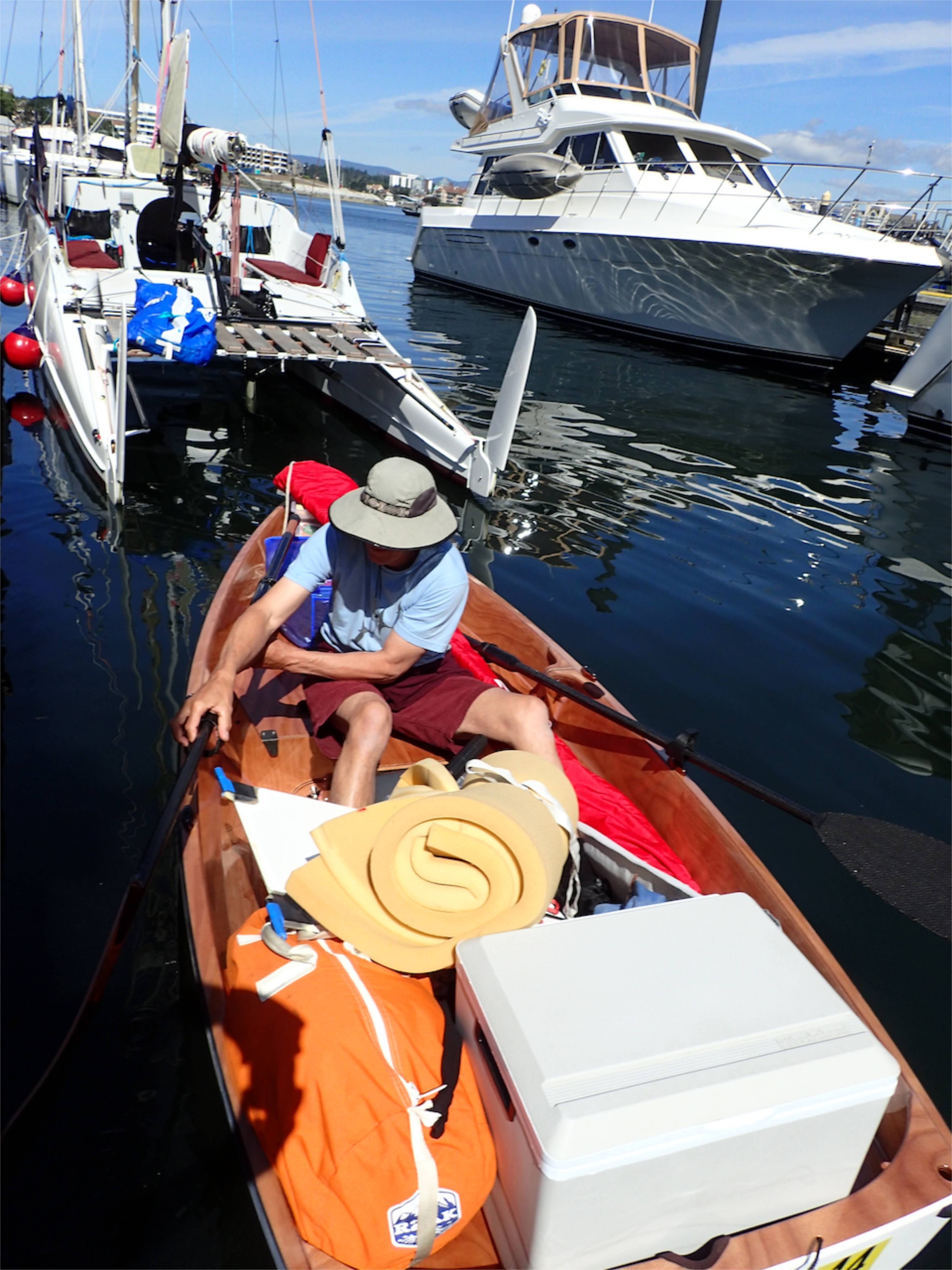
Dinghy loaded with gear ..motor, bedding, cooler…+++ We had to unload the truck from the parking lot and row to the marina.

There comes a time…

There comes a time…

…when one feels the need to alter course. Russell and I started PT Watercraft in 2009, to create an outlet to share Russell’s vision for a really good nesting dinghy. Since then, he has built 8 boats to define the build process, take the right photos and to update the manuals. A major revision of the PT11 and Spear manuals has only just been completed. He has also built parts for approximately 175 kits, including 130 for the PT 11 nesting dinghy.

By Intention, our business model has been a small and custom operation. We are more creative in nature than business minded, so expanding to include employees and larger production has not attracted us. Instead, we have farmed out many aspects of our production to the abundant local talent found in Port Townsend.
The level of detail and care put into each kit has earned us a reputation that we are proud of: that our kits take the kit concept to a higher level than others, at a price, but at excellent value for the money. Unfortunately, this is also a business model that is difficult to sell. Yes, when we started, we thought we’d create the business and eventually sell it.

What we find is that with open ended shipping dates, we never seem to get ahead of stocking parts and getting kits out the door. There are no gaps between for writing books that we have promised our book customers, nor to develop new ideas. By re-organizing our shipping schedules, we hope to reserve time for these creative endeavors. This might mean fewer kits produced but our level of quality and service would remain high.

What are the actual changes at PT Watercraft?

We have had to raise our prices. This was a really hard decision for us. In an effort to keep our prices in some sort of league with similar sized boats, we have never paid ourselves very well for the labor intensive product we produce and materials and shipping costs just keep going up. On the other hand, we are not willing to ship a lesser quality product.

Because most of our kits are sold in Fall and Spring, we are considering to restrict shipments to specific time frames within those seasons. Deposits accumulated in Summer and Winter will largely dictate the number of kits we ship.

We are suspending all exports. Exporting has always cost us more with extra paperwork and materials (heavy duty crates, for example). Customers abroad pay increasingly more for shipping and import duties. It just does not feel right and we sincerely apologize to those outside of the US who were hoping to get a PT 11 kit. Canadians can make a road trip of it or we can ship to bonded shippers on our side of the border.

What is NOT changing?

Our customers are really important to us. We are here for you and will continue to work through this transition. We are dedicated to good service and creating the nicest kits we possibly can.
Please follow our blog as we trial new arrangements. Our home page now has a clear explanation of what makes our kits special. Further details are continued on the PT 11 homepage. The website may appear a bit haphazard for a while. I am shuffling things around and trying to simplify it all.
Thank you for your patience and support.

Ashlyn & Russell Brown
March 1, 2019


As per our new homepage: the full text: by Russell Brown

Understanding the PT 11 nesting dinghy
There are many nesting dinghy kits available, but our PT 11 dinghy kit is a bit different.
Because our kits are quite expensive, we would like to offer some explanation. We would also like to make sure that our kit’s are an appropriate choice for anyone thinking of building one.
We are long-time designers and builders of high-performance sail boats. Nesting dinghies have been a passion for more than 40 years, during which time our study of the compromises and possibilities have been a bit of an obsession. Many prototypes have led to the kits that we now offer.
Could we have created a simpler and more affordable boat? Of course we could have, but it wouldn’t have the qualities that make the PT 11 such a great boat.
What features make this boat special?
The ability to assemble and disassemble the boat in seconds, in the water or out of the water. The unmatched strength of the assembled boat, a challenge in nesting dinghy design.
The rowing performance of our boats is quite amazing. One was used in a 70 mile endurance race last year, finishing in the top third of a 120 boat fleet in under 20 hours, surprising for an 11 foot dinghy. An outboard motor is quite unnecessary when using the boat as a tender.
The sailing performance is very good. The stock foils (machined daggerboard and kick-up rudder) help the boat sail upwind like a 12 meter. The rig is the lightest and easiest to use dinghy rig on the market. The two-piece carbon mast and boom, sail, and all rigging weigh just 10 1/2 pounds, store in a small bag, and assembles in minutes, making a quick sail in a new anchorage easily done.
Other prominent features include a large truly watertight storage area, sealed flotation tanks fore & aft, and a very dependable daggerboard trunk cap that allows towing in rough water and at high speeds. Two rowing stations and multiple foot brace positions allow keeping level trim with multiple passengers and allow rowers of different heights.
These qualities are combined with many other well-thought-out features, some that make construction easier and many that make the boat easier to use, lighter, and more efficient.
What do we not like about the PT 11? It’s complex. While we have not over-engineered this boat and we continually work on making the build simpler, a really good nesting dinghy, especially one that could last forever, requires complexity. Much of that complexity is on our end. We manufacture many custom parts for the boat and we aren’t shy about expensive alternatives.
The fact that we have sold so many kits for the PT 11 with almost no advertising says a lot.
Builders of the 11 see the value of the kit, the manual, and the finished product. Resale values of well built PT 11’s also point to a well conceived product.
Is the PT 11 for you? If you are attracted to the boat and it fits your needs, then maybe. Are you right for the PT11? Probably, if the next sentences work for you.
If you want the performance that our kits offer and aren’t afraid to put in the effort and time required, if you look forward to a good winter or summer project, and are willing to carefully follow a very detailed building manual.
Building a boat can be a very satisfying and rewarding experience; an experience that is increasingly missing in modern times. We ask a lot of our builders, but they get a lot in return. They get the experience, a new set of skills, and in the end, they get a very versatile boat.
Because we have very high standards for what we want in a boat, we start with the best materials:
We hand pick through units of high grade Okoume plywood to find the best looking and flattest panels of five different thicknesses of plywood. This doesn’t mean it’s always perfect, but we choose the best available and it’s a wonderful material for this type of boat. Most of the plywood parts are CNC machined, but many of them are post-machined to bevel and round edges where appropriate. The lumber parts kit (foredeck stringers, glue cleats and reinforcements) are machined from high-grade Sitka Spruce. The foot braces, oarlock riser blocks, and back seat cleats are machined to a ready-to-finish level from Sapele mahogany.
We supply the best glass cloth of 3 different weights to protect and reinforce, while keeping the boat as light as possible.
Carbon fiber alignment clips, goose-neck fittings and fiberglass mast sockets are molded “in house”.
The foils are CNC machined from carefully selected Okoume plywood (2 layers of 12 mm Vacuum bagged together on a “flat table”) to make NACA section foils of almost 1” thick. For the weight and performance offered by these foils, they are relatively very affordable and not difficult to finish.
The machined 316 stainless connective hardware is machined by Paul Zeusche, an expert local machinist and boat builder. This hardware constitutes a large part of the value of the kit and is continually fine-tuned. We are extremely lucky to have some very smart friends.
The masts and booms are made in state by ICE, a maker of the highest quality carbon fiber tubes on the planet. The two-part mast and boom (almost 23 lineal feet of tapered custom carbon tubes) weigh just 6.7 lbs and that includes all the hardware and running rigging on the boom (5 Harken blocks, 2 snap hooks, 1 s-hook, 7 eye straps, 1 cleat, 37 feet of running rigging, and a goose-neck fitting.)
Many other parts and pieces are produced in our shop or locally. Besides the plywood, which is made in France, just about everything in one of our kits is made in the US.
The most valuable single piece of the kit is the building manual. We don’t encourage people without hand tool experience to build our boats, but the manual allows someone with no epoxy or boat building experience to build a really good boat.
It’s just the two of us running PT Watercraft, which means we can offer very good quality control and economy,
We are now completing our 8th PT 11, built to improve the manual and fine-tune the kits (as were the other 7). We do this so that our builders can get the most value, pleasure, and longevity from their boats. The kits and manuals for the PT 11 and PT Spear are getting better every year.

We have also been working on a video series with Off Center Harbor, showing the more technical parts of building a PT 11. These video’s will be available free to our builders. We hope builder will follow the blog for important updates.
Featured comment from March 2019: “ I would like to reiterate one point as far as the value is concerned: I’ve yet to float in my boat, but I’m confident it will work as designed. The money spent was worth it, just to have “taken the class” on working with epoxy, and stitch and glue boat building, getting a sweet boat at the end is of course a nice bonus. The manual describes such nuance of technique, I feel like an expert, despite limited experience with epoxy and glass. That said by a working guy on a budget.” A.S. Stowe Vermont

…
Race to Alaska; leg 2 video

5 months after the 2018 Race to Alaska, I am finally getting a video published of Russell’s second leg to Ketchikan. I won’t deny that some of us were freaking out watching this race in the first 3 days as Russell pulled ahead of the leaders every day in spite of sleeping every night while the boats with multiple crew were underway non stop. It shows just how fast the Gougeon 32 catamaran can be in the right hands.

After that third day in Johnstone Straights, passing the lead boat, Team Sail it Like a Girl, Russell debated the sanity of what he was doing. That day had presented frustratingly light winds to sudden micro blasts that threatened serious harm, and after waking up Day 4 to total calm and contrary current, he waited for a favorable current and made the consious decision to focus on finishing without destroying the boat rather than trying to continue leap frogging to the lead.

There was a lot of pedaling done during this race; a lot of drifting, a lot of getting roasted in the sun. The multitude of drift logs, kelp rafts, and breaching humpback whales demanded that crews remain seriously alert. It was not until the 7th day of Russell’s race, that he had consistent wind all day. That was his 130 mile run from Aristazabal to Dundas Island where he kept his promise to himself not to sail in the dark. He regrets that choice only a little, mainly because he got badly bitten by black flies and in retrospect, he would have enjoyed wind had he just kept going.

His crossing of Dixon entrance was fair enough but the wind died as he entered Alaskan waters and that last stretch was grueling and wet with rain. Russell did not know who was nearby until he figured out that the high powered trimaran, Team Wright, was very close. That gave him the gumption to push harder, wanting to finish ahead of the bigger multi-hull. He succeeded but he was tuckered out from pedaling for hours by the time he stepped onto the dock. He spent his next few days nursing waterlogged feet…or, trench foot being another name.
He finished in the evening of his 8th day, counting from a noon start in Victoria to noon + 4 in Ketchikan and thus broke his own solo record from 2017 by a day. Happy to have made it, he remained humble and shy of the spotlight but I was pretty tickled he had done so well. The real joy of the R2AK for us, is the trip home and you can trust with me ever grabbing the camera, that there will be more photos and videos to sort though.
I hope to follow this video with some of those clips soon.  Follow the link below to see a video of Russell’s 2018 race from Victoria to Ketchikan.

https://youtu.be/kubraaN57UI

Tracker screen shots highlight his daily progress.

ptwatercraft.com
June 17, day one. The purple track line is Russell’s.
ptwatercraft.com
Day 2, Team PT Watercraft in the lead… a different view and scoreboard.
ptwatercraft.com
June 19th after a night stop on the north end of Hornby.
ptwatercraft.com
Reaching Seymore Narrows June 19th. I like how this shows the spread of boats.
ptwatercraft.com
Taking the lead again in Johnstone Straights; see video.
ptwatercraft.com
6:00am June 20th, Team PT Watercraft still tucked into an anchorage waiting for favorable current and some wind; allowing sanity to prevail, while other boats had struggled all night to make headway against the current…
ptwatercrfat.com
Russell passing Calvert Island June 22nd.
ptwatercraft.com
Russell makes Bella Bella by the end of June 22nd.

This was the last tracker shot I could save before racing myself to Seattle to catch a plane to Ketchikan. I had to be there for the finish!\


A.E. Brown

2018 Race to Alaska leg 1

I made a clip correction on our leg one video of Russell’s Race to Alaska. (the new video is below)

This is the start of the race from Port Townsend to Victoria. Alex Spear and myself were on board for that portion of the race and we finished first (!) nearly an hour ahead of the next boat, which was a little lonely but exciting too. I have a few clips of Russell’s race to Ketchikan and a lot of video from our return to Port Townsend. It will take some time before I pull a decent video of those together. AEB 😉

Award for the PT SPEAR

ptwatercraft.com

This year was the 39th annual Victoria Classic Boat Festival.  Among our friends who participated, Alex Spear was there with his beautiful boat, Vito Dumas and her tender, ‘Pato’, a PT SPEAR. ‘Pato’ is in fact the very first PT SPEAR.
In Alex’s words, ‘An esteemed panel of judges, including our local Carol Hasse, selected the PT 11/SPEAR as the “best open sailing vessel in the show”.’
This is a great honor. According to Alex,  ‘Pato’ was not independently entered in the show but it garnered so much interest and attention from the judges that they deemed it worthy of mention. Our humble gratitude goes out to the judges.

ptwatercraft.com
Vito Dumas and tender, Pato, at the docks in Deer Harbor.

From Victoria, ‘Vito Dumas’, ‘Sir Isaac’, ‘Sparkle’ and other familiar and beautiful wooden boats converged at the Deer Harbor Wooden Boat Rendezvous.
Vito Dumas and ‘Pato’.


Below, Looking back on a rainy Deer Harbor.

ptwatercraft.com
Looking back on Deer Harbor as we head back to Port Townsend.

Custom mast prototype-stress test

Since we first started selling kits for the PT 11 we have been continually updating the kit, building process, and the boat to make it better.  It’s in our nature to do this and it means the boats get stronger, lighter, easier to build, perform better, etc.

ptwatercraft.com
click the photo for a detailed post about our rigs.

A good while back, through friends in the high tech world, we developed a connection with a company called Innovative Composite Engineering, a renown carbon tube company in Washington state. They now make our lightweight booms for the sailing rigs.

The 7 1/2′ booms are incredibly lightweight. The tubes start at 20 ounces each. With the gooseneck, hardware, main sheet & vang tackle, they weigh 40 ounces.  No one is likely to get knocked out by one of these booms in a gybe and so far they have been strong enough (remember not to over-do the boom vang).

While the masts we sell have been extremely reliable, we knew they could be lighter. After a year of bugging I.C.E. to come up with a mast for us, we finally got a prototype.

The masts that we have been using are modified windsurfing masts. We have to modify them because they are stepped in a short socket and the loads where the mast comes out of the socket are quite significant and different than the loads applied to a windsurfer mast.
The new masts have extra layers of carbon at the lower end starting just above deck level and ending just above where the boom connects to the mast. These extra layers of laminate mean that we will have to do less work to the lower end to make them strong enough.

How light is the new mast? It’s light! The current two-piece masts weigh 104 ounces (2937 grams); already impressively light. The new mast weighs 69 ounces (1950 grams)!

We stress tested the prototype mast as shown on land (and on the water) using two 180 pound people on the rail and the mast was fine.
Having two people on the rail is strongly discouraged by us because of the twisting loads it puts on the boat, the very high loads at the mast step, and finally the mast.
In other words, what we are really after is a feather weight mast, not a mast that could break the boat.

The weight of the rig is directly related to ease of use. Our theory (and it seems well proven now) is that the easier the sailing rig is to use, the more it will be used. Our rig was already the lightest, easiest to use, and most power-per-pound dinghy sailing rig out there. Now it is significantly lighter.

We will pay quite a bit more for the custom masts, but because they will be less work to finish we will likely be able to keep the complete sailing rig cost the same.

ptwatercraft.com
Ashlyn can’t get much mast bend.
ptwatercraft.com
Russell and James hike out with approx 360 Lbs.

ptwatercraft

We did a load test on the ground, tying the mast to a building and getting two people hiking out on the rail. This was a little scary, but a very effective way to see if the mast was strong enough. (RB)

Ashlyn’s footnote: Our ballast assistant in these photos is a local luthier. Here he is holding the 15′ 1″ mast up by the tip to see how it sounds as a Didjeridoo.

PTWATERCRAFT.COM
What sound can it make?

See this silly video to hear….

I had him lower the tip for the video because, in the camera, the green house behind appeared to dominate. I regret this now since it would have looked fine. It was impressive how easy it was to keep it up in the air. (AEB.)