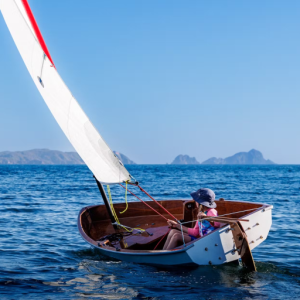
PT Watercraft designs dinghies that are efficient, functional, modern, and attractive—available as kits you can build yourself. We also carry small boat parts and instructional books.
I am including this post because I think it is interesting and…
Suzanne Snadecki paints her dream into reality..
it involves my family doing something pretty amazing. My mother, who lives in France, woke up one morning and decided she wanted to travel around the country in a horse drawn gypsy wagon. A long time sailor herself, this will be her ‘boat ashore’. Not one to do anything half way in spite of a shoe string budget, she has made major progress toward realizing her dream from scratch in little over a year.
BSD-Batwing (™) sail creator and founder of Balogh Sail Design, MARK BALOGH,
Suzanne has been raising the money for the project in small doses, with her paintings and donations from inspired friends. Her blog is rich with humanity, color, and the unfolding story of the project happening in the scenic country side of France. The project has also become a statement about slowing down in a world that seems to have forgotten how to look up and see the beauty around us.
Those who are familiar with The Gougeon Brothers on Boat Construction (link leads to a free digital version of the book) may have read the chapter on a type of boat building called; “compounded plywood construction” also known as “tortured” plywood. It is the method used to create the famed Tornado catamaran hulls. Russell has recently been exploring this method. Click HERE to see a 6 page pdf as just a taste of what he has learned so far.
Speaking of the Gougeon Brothers, the current issue of Woodenboat Magazine has a feature article about Meade Gougeon.
Scarfing Basics is the latest ‘how-to’ book by Russell, since publishing Epoxy Basics in 2013. These books do not come into being casually. Every photo requires a good subject and what presented itself in the shop in between ‘business as usual’ this summer was scarfing. There are often ‘how to scarf’ questions online and a wide range of opinions shared that can sometimes cause more confusion than real help. The builder is still left to pick and choose how to proceed. For Russell, “strong, clean, and accurate” are the words of the day. This book describes the methods he prefers, in direct, concise language and large color photographs. While there are multiple ways to scarf plywood and lumber, this book is a great place to start and/or perfect your scarfing skills. Amateur and professional woodworkers alike will find a lot of good information and tips in this book for Cutting and Gluing, Strong, Straight, and Clean Scarf Joints in Plywood and Lumber, including making your own jigs for table saw and router.
The book is currently in its final proofing stage and will be available as an ebook first, and as a print book in late January from Port Townsend Watercraft.
The PT 11 is known as a “nesting dinghy” and while many people know what that means, many again, do not. It is easy to explain that the boat can be separated into two parts, and the bow half ‘nests’ in the aft half, making it possible to own a relatively large dinghy that will store in a relatively small space, such as, on the deck of your boat. I had assumed that the term “nesting dinghy” referred to exactly that. In our circle of boats and dinghies, it does, but is it the right term?
Not everyone gets it right away..
The internet provides lots of definitions that all begin with the base word NEST. My 4” thick Random House Dictionary of the English Language defines “nest” in the 9th definition as,”to fit or place one within another”… Or the 12th: “ to fit together or within another or one another..” This definition works until I get asked if it means that one or more of our dinghies stack well. The fact that the dinghy comes apart into two ‘nestable’ parts, is left out of the equation. The word “nesting” is not even in this big dictionary. It is online and I kind of like this one lonley meaning for the word even if it is related only in an abstract manner ; nesting — adj, nesting (ˈnɛstɪŋ) — n the tendency to arrange one’s immediate surroundings, such as a work station, to create a place where one feels secure, comfortable, or in control.
I have also had people ask me about our “nester”. Looking up the definitions for this was interesting. In my big old dictionary, “Nestor” is the wisest and oldest of the Greeks in the Trojan War. In the urban dictionary online however, see this screen shot:
urban dictionary definition of ‘nestor’
But that is nestor with “or” and I usually get “nester” with “er”. “Nester” is not in my dictionary but it is online and not exactly fitting. Look at the urban dictionary definition too. This was new to me! You can be sure I will refrain from casually using the word “nester” when talking about our beautiful dinghy. 😉
internet screenshot
Urban definition:
urban definition of ‘nester’
I think, after this belated study on this terminology when related to the PT 11, we can settle on something closer to the following: The PT Eleven is an 11 ft, two part dinghy with nestable parts that store in a 6ft by 4ft 2 inch by 20 inch space.
You probably know where to find more info on our PT Eleven nestable dinghy kit and if not, click HERE.
Thank you for following! PTW 😉
More NEST definitions. (I deleted the bird and insect references…) nest noun … 4. a snug retreat or refuge; resting place; home. 5. an assemblage of things lying or set close together, as a series of boxes or trays, that fit within each other: a nest of tables.
verb (used with object) 8. to settle or place (something) in or as if in a nest: to nest dishes in straw. 9. to fit or place one within another: to nest boxes for more compact storage. verb (used without object) … 11. to settle in or as if in a nest. 12. to fit together or within another or one another: bowls that nest easily for storage. … Origin: before 900; Middle English, Old English (cognate with Dutch, German nest; akin to Latin nīdus nest, Old Irish net, Welsh nyth, Sanskrit nīḍa lair) ≪ Indo-European *nizdo- bird’s nest, equivalent to *ni down (see nether) + *zd-, variant of *sd-, ablaut variant of *sed-, v. base meaning “sit” (see sit) + *-o- theme vowel
We recently finished our sixth (yes, sixth) PT 11 prototype. This was to incorporate a few design changes and re-write much of the manual in an effort to make the boat easier to build. Building this many boats can lead to some labor saving ideas and we felt that we needed to do our best to make this, “kind-of-high-tech” boat as easy to build as possible.
In the last related blog post we detailed some of the changes we have made to the boat. Everything worked well, the new manual is done, and kit parts are stacked to the ceiling and ready to fly out the door.
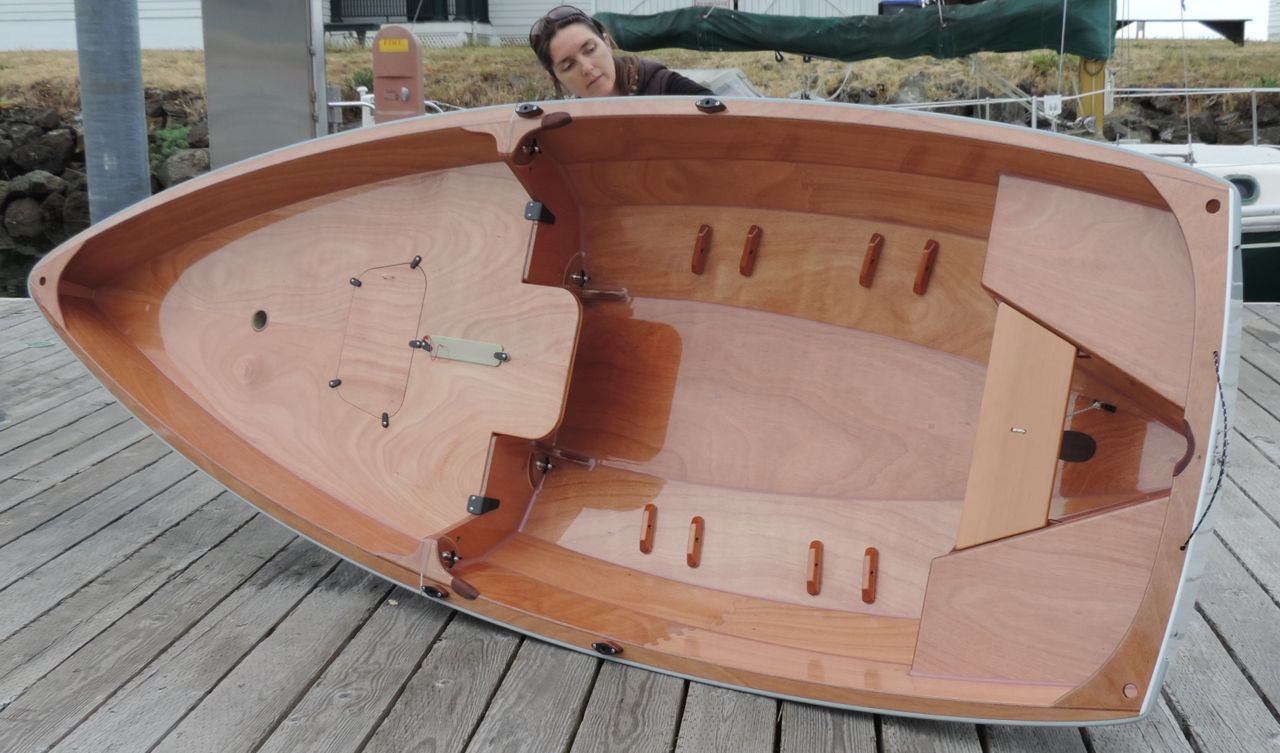
transom inwhale with bow notch allows for a more snugly nested package.
Relevant details even if you already have a PT11;
We have a few new details to share. Most are in the new manual but could be useful for people that already have PT 11’s.
The back seat had two issues: One is that the seat needed a way to be held against the tank wall when nesting the boat. For some reason we never realized that if we trimmed 1/4” off of the aft edge of the seat (it’s now 7” wide), it could wedge between the cleat and the shock chord knot as shown below. It’s secure enough not to fall over when nesting the boat and that’s all it needs.
seat wedges neatly when ready to store the boat nested.
The other issue is that the back seat could slide forward, (even with the bunji cord) come off the cleats, and drop you on your butt.
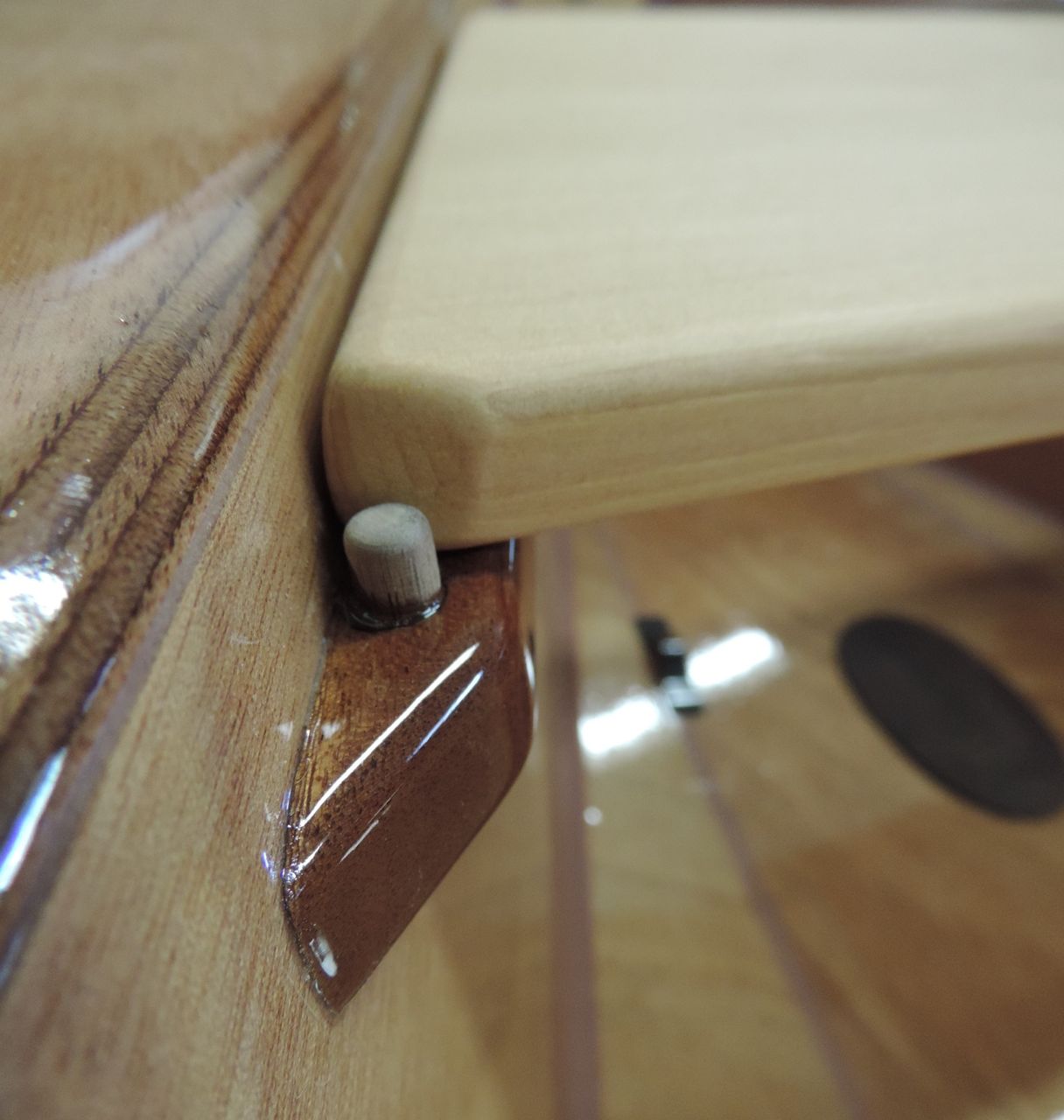
The fix is pretty simple. We trimmed a bit from the outboard edges of the seat with a sanding block (to move the seat aft) and we block sanded the forward corners of the seat as shown, all so that there was enough cleat showing to drill holes in. We then drilled 1/4” holes to a depth of 3/8” for the 5/8” long hardwood dowels to glue into.
This works well, it’s an easy fix, and if you already have a boat, we can send the dowels to you along with the handy-dandy tether washer we shown below.
See the dowel stopper in the bottom right corner of the photo.The back seat dowel stopper prevents the seat from slipping forward.
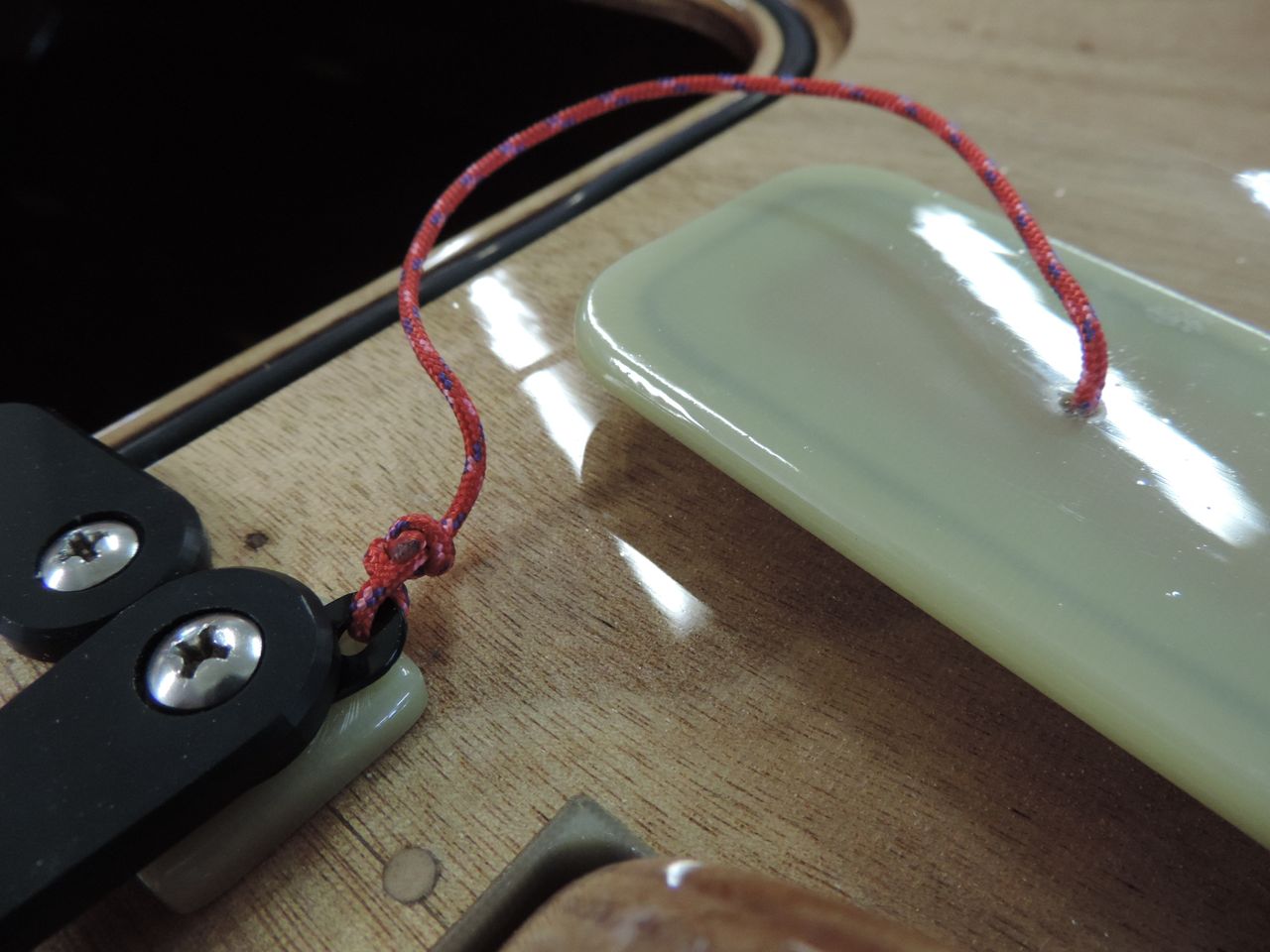
Custom machined Delrin (TM) washers with tether loop.
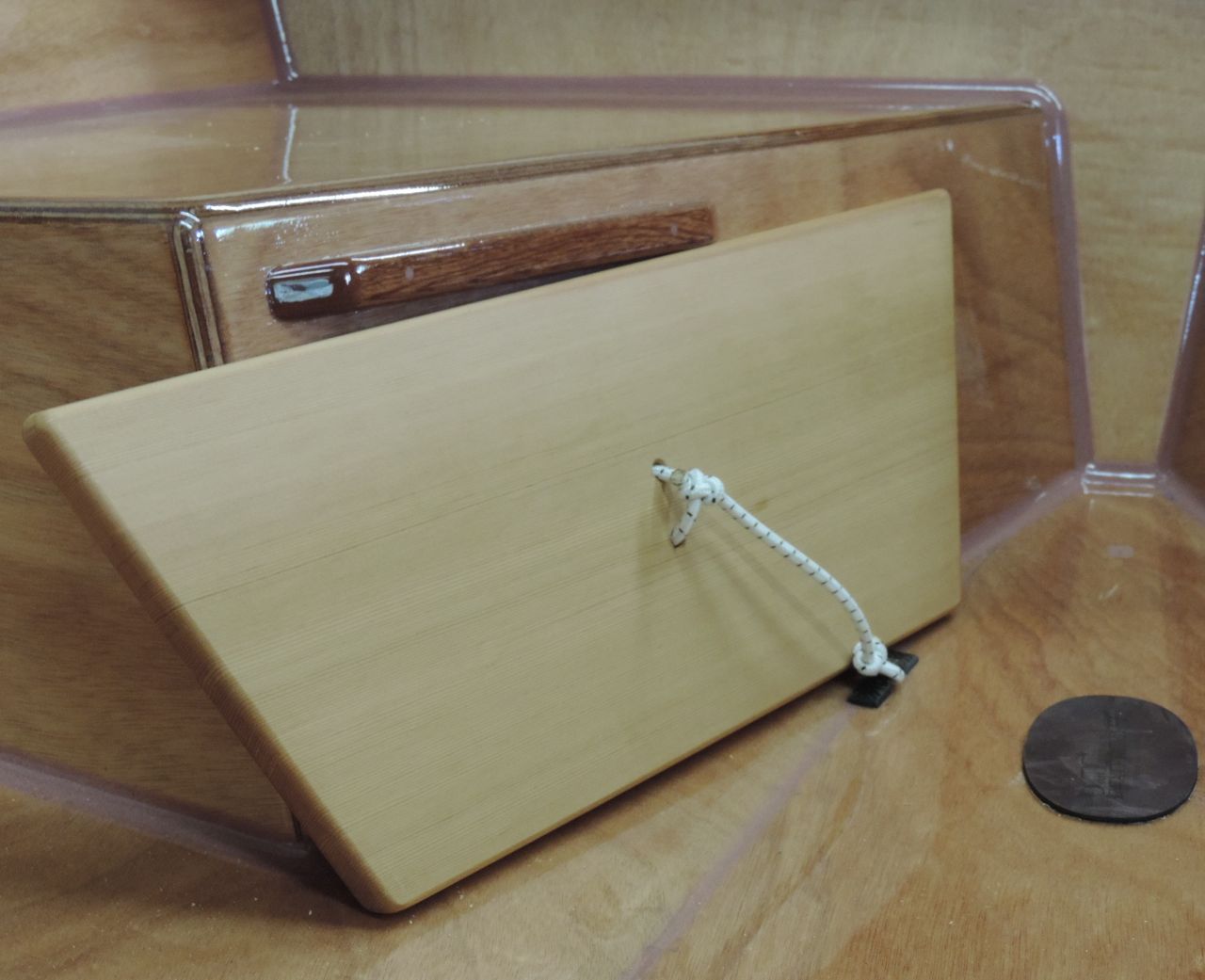
We have always kept our dagger-board trunk cap in the forward compartment, but it can be hard to find in there if it’s full of stuff. It’s easy to glue a tether into a hole drilled in the cap, but where to tie the tether? To the washer under the forward turn dog, that’s where.
It’s a special washer made for us by a neighbor who laser cuts other parts for us as well. This is a thin Delrin(TM) part, but we had a very hard time breaking one.
Replace the round washer with this one and rotate the washer aft for fishing the tether through the hole.
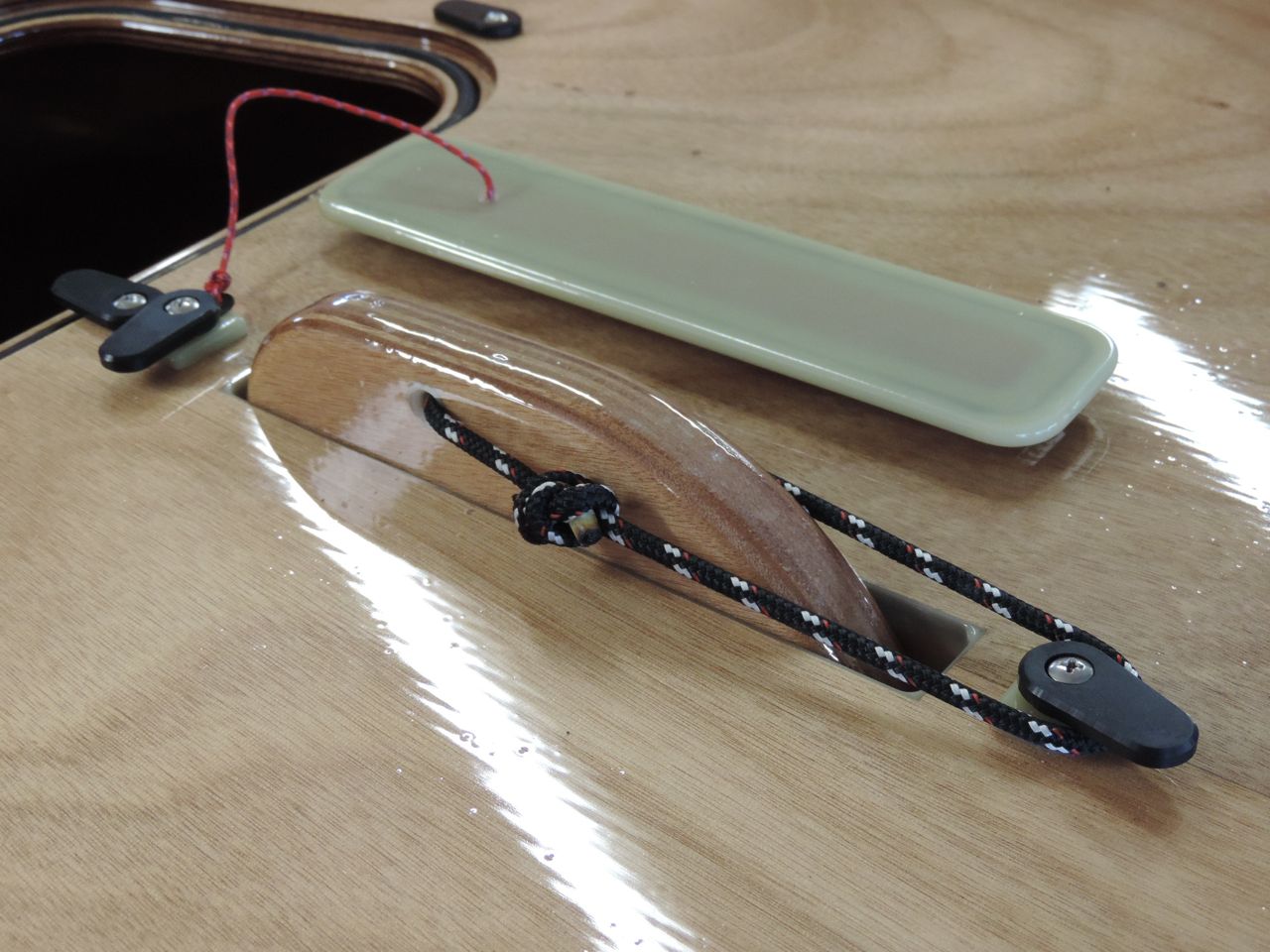
PT 11 dagger-board trunk cap with tether.
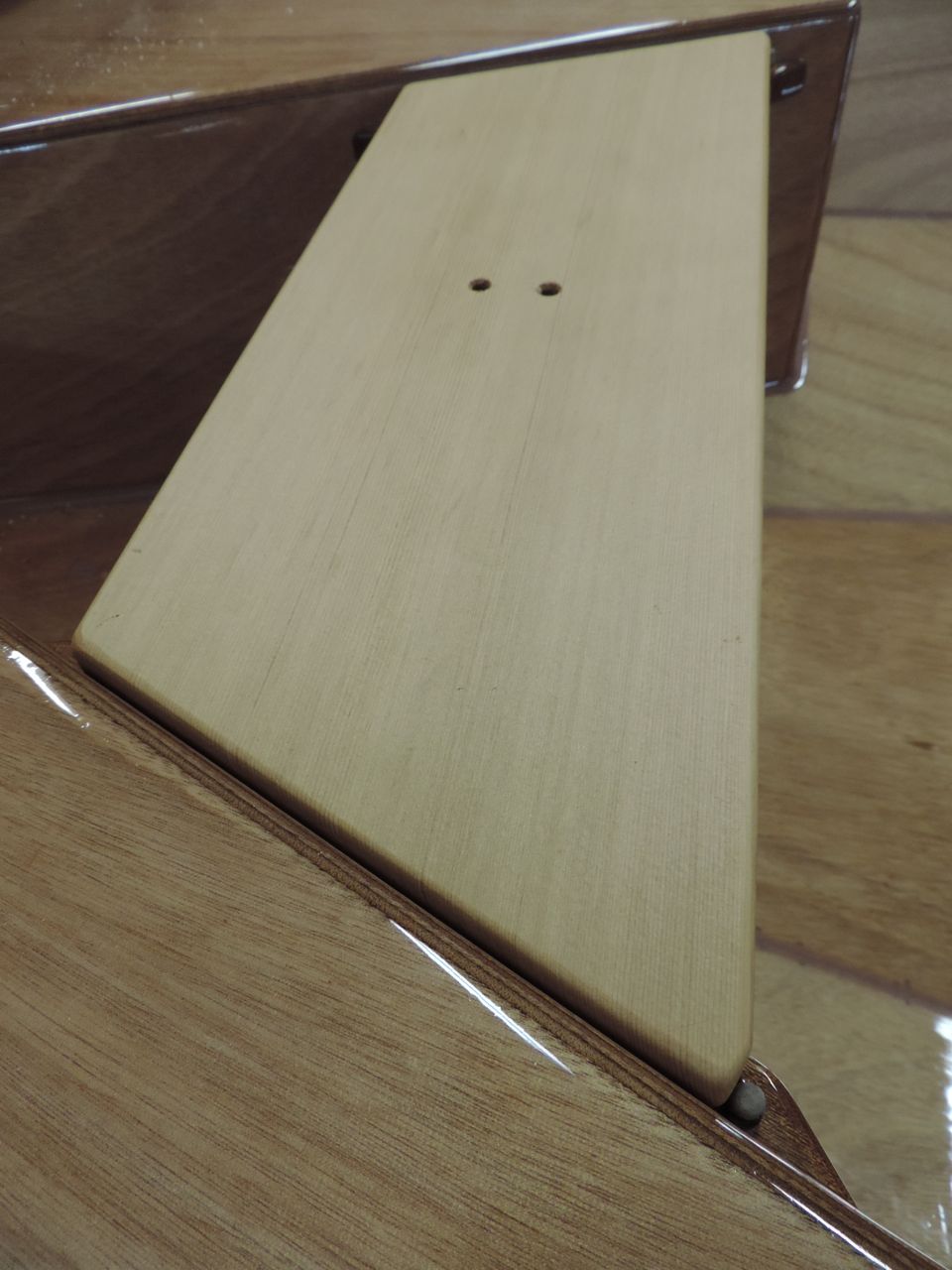
Holding the dagger-board down has always been done with a rope loop that can hook over the aft turn dog, but having the loop fairly snug (as shown below) keeps the board down all the way.
Having the loop the right length keeps the board down all the way.
Having the board down fully will make the boat climb like a 12 meter when sailing upwind and it will also help you run aground. No, what I meant is that it will help if you run aground.
-showing the dagger-board fully down at the underside of the trunk.
We hit a rock very hard and not only did it nearly throw us out of the boat, but the sharp trailing edge of the board hit the aft end of the trunk (because the board was up about four inches) and did a small amount of damage to the trunk. The dagger-board was fine, but we now sail with the dagger-board down all the way or we unhook it and let it float up (about a third of the way).
Since we began producing the PT 11 kit, all of our costs have gone up. Plywood, CNC machining, and everything else we use has increased in price.
For now, we are holding the price of the basic kit where it has been since we began but we need to increase the prices for the rigs and foil kits.
Our sailing rigs are getting both better and lighter. These rigs are not a kit. They are ready to drop in the boat and go sailing. All the spars and some of the fittings are carbon fiber, the hardware is Harken, and the sails are beautifully made out of top materials. The unfortunate fact is that they are also more expensive for us to produce than when we began. (Clicking on the photos below will lead to detailed posts, in new frames, about the rig and foils kit.)
Our foils take a surprising amount of materials, CNC time, and handwork. Like everything we produce, these parts are clean, efficient, and nice to look at. Not your average kit dinghy foils…
Click on Photo to see a full post about our foils kit.
Having a bailer in a dinghy is a very important thing. Dinghy sailing in gusty wind can get wet, especially if the captain is not paying attention and dips the rail. Russell came up with a handy bailer idea. This oblong fabric softener bottle offers both a wide mouth scoop and a low profile that fits neatly below the seat tongue. Stashed inside for minor spray is a sponge. This green sponge was a waste of pennies. It does little more than spread spray water. A good absorbent sponge like this PVA sponge or 3M C41 7456-T is a much better choice. I personally like these pop-up sponges but they do not hold up well if left outside, which is kind of the point environmentally.. 😉 This bailer installation does not interfere with nesting. There is room to spare. We used carbon glue on eyestraps and a bungee cord to keep the bailer stored out of the way but within quick reach.
Experiment 2012 to create a kit for oars: High density foam and carbon fiber blades. Unfortunately, these kits would end up being very expensive as they require a lot of time and effort on the part of Russell. With all that he has to keep up with, this kit would not make sense for us. We have decided to leave oars to oar makers but thought you might find these pictures interesting. Please see our oars links page for oar resources. Do you know of oars that you really like? please let me know so I can add a link to the links list! Thank you.
1
2
3
4
5
6
7; finished oars. solid epoxy edges. Douglas fir shafts.
Would you like to make your own oar blades and small hardware? Russell has published an e-book /book about working with epoxy. More detailed topics are on the agenda for future publication. Have you seen our e-books/books page?
We made it through another great festival! The festival weekend is a long one for us. It seems like we never really stop talking for 3 days. But our local wooden boat festival is so much fun and the people who visit us are truly wonderful. It is great to see our customers, old friends, and make new friends as we all talk about something we are passionate about; boats. This year the Nesting Dinghy and the Non-Nesting dinghy were both well received by our audience. Our apologies to those who wanted to see the PT Skiff this year. We did not have one to show and had we had our thinking caps on straight, we might have arranged it.
I did not get many pictures this year either. I will include a few here and a video link that came to my attention this morning. Someone had a really cool drone filming the festival from above. Check it out. http://www.youtube.com/watch?v=JBETdyNi0y8
Thank you to all and we hope to see everyone next year. Mark it on your planner!
Mornin’ Skip! Skip Allen’s “Wild Flower 2” in the foreground.Builder of the PT Skiff, PIKA in his new, family built, original design, motorboat, Syhoja. Powered with a 60HP E-TechThe ferry looking like a horned sea monster in the fog.Across the docks.A classic PT Wooden Boat Festival scene..Oh those reflections…Morning RowersSteam and Sail in the fogRussell and Dana doing the nesting dinghy demo. We should have kept count of how many times we did this. Good thing it is so easy to do!