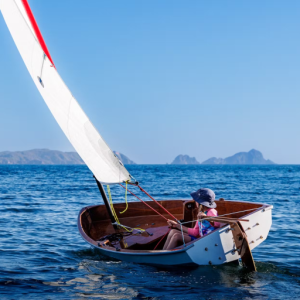
Work on a slightly re-designed PT 11 and a much improved building manual for the 11 is well underway.
We have long been planning to develop a smaller version of our nesting dinghy, but for several reasons, we decided to focus our efforts on making the PT 11 as good (and as easy to build) as we can make it.
One reason for this decision is that we are a small company with no employees (just ourselves) and even though the design process for the smaller boat was well underway, the thought of needing to stock all the parts necessary for a smaller boat seemed like too much.
Very few of the parts for the bigger boat would fit the smaller one. Even the rig and foils would need to be different, so the PT 9.5 has been put aside... For now.

The PT 11 has been a constant evolution. I have built so many prototypes and modified the manual so many times that I have lost count, but we love the boat and it has become quite a popular kit.ptwatercraft.com

The new changes in the boat (and the manual) are mostly aimed at making the boat easier to build.
The biggest change is to make the gussets both thicker and slightly larger so that the builder can avoid the tricky job of applying the structural fiberglass over the gussets, besides making sense structurally.ptwatercraft.com
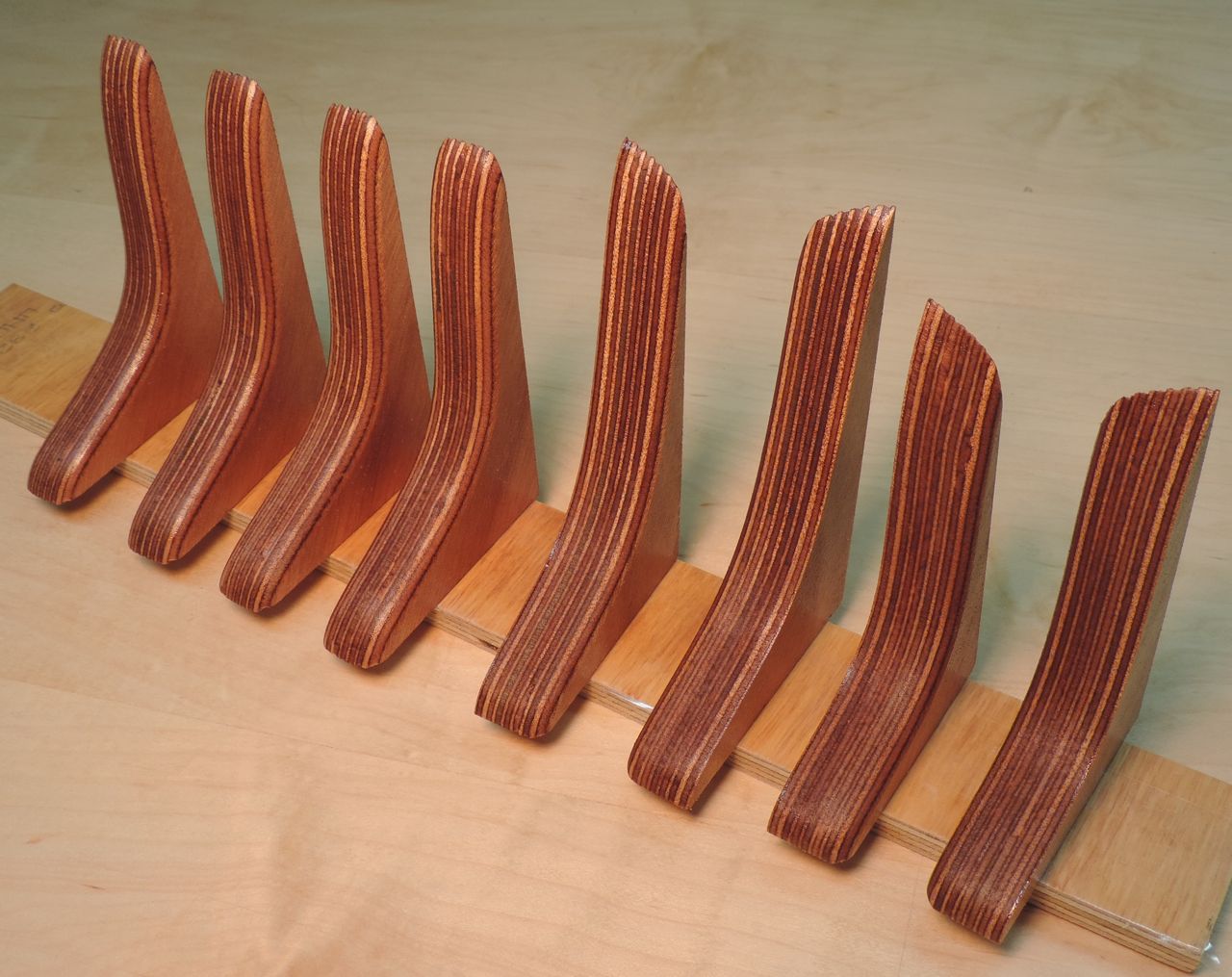
The gussets will now be pre-beveled so that the upper gussets fit the hull without the builder having to do it and the curved gusset edges will be pre-rounded so that builders without router tables can avoid the risk of rounding their finger tips.
We wanted to make the two halves of the boat key together more snugly when nested, so the transom inwale is now wider and has a reinforced notch cut into it that the stem fits into when nested.
That, along with the larger gussets will mean that the forward half will just fit into the aft half, and once it’s there it won’t be able to move.
We will have the new boat cut in half soon to check our tolerances and then machine new gussets and inwales for future kit orders.

In the manual we are changing many parts of the process, mostly just to clarify parts of the process with more photos and better text, but some parts, such as the process of fiberglass taping the chines has been changed to a much better method, one we have used on the last couple of prototypes.
We have also been working on a video of some of the more challenging parts of the process. This video will (eventually) include filleting, chine taping, glassing, gloss coating, and painting.

PTW

As of Monday, April 7 th, our PT 11 nesting dinghy will be on display at Fisheries Supply in Seattle. This is something we have talked about doing for a long time and we are pleased it is happening this year. Fisheries Supply is one of our very favorite resources.

On display is our PT 11 that we have used a lot for 3 seasons now, around Port Townsend and north into Desolation Sound, BC.  We have done a lot of exploring in this boat, some of which is featured in our videos. The interior finish is still the original WEST SYSTEM EPOXY(R) clear finish using 207 Special Clear Hardener(R) done in 2011.  It is due a coat of varnish but I think you will be impressed at how little the scratches show even after all the sand and shoes.   So if you are in the area, please stop by FISHERIES SUPPLY and check the boat out! Let us know you stopped by.  THANK YOU! ptwatercraft.comptwatercraft.comptwatercraft.comptwatercraft.com

ptwatercraft.com
Loaded with gear commuting to our boat's mooring, before taking off for Canada.

More boats are getting wet this year. I am really enjoying everyone's news.

Olav in Victoria BC launched his PT 11 earlier this year. I like the below photos in particular. If you had to choose a dinghy to be proud of for your beautiful cruising boat, would it be like those in the back ground? Or more like the sleek hull in the fore ground??  Beautiful job Olav!  😉

ptwatercraft.com PTwatercraft.com

James in Australia launched his PT 11 this winter (summer ,'down under') with his son. I received these pictures in January. Again, a great job on the boat!! ptwatercraft.com ptwatercraft.com

BLUE WHALE ADVENTURES is headed into the Pacific with a PT 11 that was recently built by Cape Fear Yachtworks. Fair winds and happy adventures!

It sure is fun when folks get colorful. This sunny yellow PT 11 is sure to turn heads for Gregg in California! I continue to be impressed with beautiful workmanship. I may be able to publish more photos soon as the weather warms and folks get out on the water.ptwatercraft.com

Is your PT 11 or PT Skiff in the water? I would love to feature it next. 😉 PTW

We recently had the opportunity to test drive a Lehr outboard on the PT 11 nesting dinghy. http://golehr.com/lehr-marine/
I should say up front, that we are personally anti-outboard for this boat. The PT 11 is lightweight with a hull shape well suited for easy, near effortless rowing, even for longer distances. The sailing rig is also very easy to use. Our vision has been that this dinghy can be a tough, utilitarian, and totally enjoyable alternative to inflatables, as tenders for cruising boats.  Even so, the PT 11 can be used with a small outboard.  We have calculated that a 2HP outboard would be plenty of power to move this little boat with ease and also keeps the PT 11 within a certain USCG category.

In our opinion, however; those who expect to use a motor on their dinghy more often than not, might be better off with a different dinghy. One could choose a boat with a fuller aft end. Rowing performance would be compromised but these boats would plane with a 5HP motor.
There are, it seems, few, new model outboards of 2HP or less.  Most outboard producers currently have models of just over 2HP. Other than the perceived "need for speed" from the general public, we are not sure why they have chosen to discontinue lower HP motors. See a PT 11 test drive with an EP CARRY.
For the sake of experiment and because this motor was offered to us for this purpose, we went ahead and made a test drive.  Thank you to J.S. for this opportunity.
Here is what we found and there is a link to a short video at the the end of this post.

I. Motor: New Lehr 2.5HP propane outboard. ( 15” shaft, cost: roughly $1050)
Port Townsend Watercraft
II. Weight: We feel like this motor is quite heavy at almost 39 LBS(incl small 1 LB gas bottle)

III. Noise: Moderate.

  • Comparison:
  • On forums online, the Honda 2.3 has been proclaimed as very noisy.
  • Electric motors are obviously the most quiet.

IV. Speed: The Lehr 2.5 propelled the PT 11 with a single, 180 pound operator, at 6.8 knots, at full throttle in protected waters.

  • No comparisons at this time.

V. Trim: The PT 11 is light weight. The weight of the motor being nearly half the weight of the boat, and with a single operator having to sit far enough aft to reach the tiller, causes the bow to ride high. One would need a tiller extension to be able to shift driver weight forward.

Port Townsend Watercraft
Taking off at full throttle..

VI. Mounting: The outboard was mounted with a raw mahogany block just below the inwhale. For the purpose of this demo, we adhered it with double sided tape. For more permanent installation, we would advise exchanging the bolts on the top gudgeon, for screws that bite into the block. On the outside of the transom, we used raw mahogany strips. The block and pads are to prevent crushing or denting the hull skins when tightening the clamps.  For a motor this heavy, we recommend re enforcing the transom with vertical ribs adhering to the buoyancy tank walls and butting up to the underside of the inwhale. This would be light and effective. Port Twnsend Watercraft

Port Townsend Watercraft

VII. Conclusion: In general, if you are set on mounting a motor on the PT 11, it is preferable to choose a motor that weighs less than 30 LBS. We will be making some effort to mount and test drive the Electric Paddle in 2014.
Click here to see a short video of the PT 11 with the Lehr 2.5HP.   PTW 😉

Note: If any of our builders have tried a small outboard on your PT 11, please contact us with your experiences.

UPDATE: This information was sent to us from one of our builders in Florida. The HP used exceeds sanctioned HP for this boat but the results are informative.

"Today's Sea Trial:  Salt water, 75 degrees, sea level, iPhone GPS.

POWER:  2.5 HP (rpm restrictor removed to increase to 3.3 hp), 1990 vintage two stroke, factory propeller, 27 pounds, Mercury outboard with tiller extension.

Life jackets, paddle, no additional gear.

Top speed, one 140 pound operator, 10 mph.  
Top speed, two people 330 pounds, 8 mph.
Top speed, four people 810 pounds, 6 mph.

Ideal cruise "sweet spot", two people, 6 mph.

Boat exceeded all expectations. " (Video below)


More PT Watercraft boats are hitting the water! Here are some to spotlight;

Simon and "crew" happy after launching in New Zealand.  I quote Simon, "I didn't really realize how much of a delight to build she's been until the bumper had been stuck on and I was a little disappointed that there wasn't anything left to do except go sailing."

The blog for this build is great. Simon took wonderful photos of his progress. Check it out HERE.

PT 11 nesting dinghy in New Zealand ttMelody_cityscape

I really like the red on the PT 11! Great choice of color!ttMelody_scootin

Garland has finished his PT Skiff in Virginia! The first one to be built on the East Coast and the first with self bailing installed. Congratulations!  Looking very classy! garland's skiff

While taking his time to build the boat, he wrote, "“The other thing that delays me is I enjoy it too much! And it relaxes me. I stand back and admire the quality of the wood, and how things look. Once it takes shape, I'll admire how  the flat panels pull together to make the graceful curves.”IMG_1096_1 IMG_1099_2Garland says.."we launched Sunday, and carried a real load! Five adults and two dogs. Considering the load, we did well. I was prepared for the boat to be tender, and she was, but not bad."

Not everyone has a camera handy, even in the age of fancy phones. I still want to congratulate James in Olympia on his launching of his PT 11 this year.  I am looking forward to pictures! See his blog with some construction photos HERE. Awesome glosscoat!

Wouldn't it be fun to have a fleet of dinghies and skiffs at the Port Townsend Wooden Boat Festival in 2014??!!   My thanks to everyone for doing such lovely work on their boats. These kits are very detail oriented and our growing family of builders appears to be putting heart and soul into their projects and I must say, it makes us feel really good! Thank you! 😉 PTW

When it was suggested by our local sail maker (NW SAILS & CANVAS) that we should come up with a distinctive insignia for the PT 11, I had to do some research. I looked at hundreds of existing insignias for sails. Some were really fancy, others were on the verge of pathetically bad, and others were very simple and yet, very effective. My goal was to create one that fit into the latter category. I had some pretty bad ideas along the way.. is it a bat?PT?getting closer?The Pacific Swift silhouette was a step in the right direction. From here I personalized it with the signature puzzle joint from our local CNC shop,(Turn Point Design) used in all of our kits in place of the traditional scarf joint. I showed it around to my 'honorary advisers' (as I generally do with most of my ideas) and I got positive feedback from lots of people. It stuck and.. is on all of our sails and much of our promotional materials. Below is the final insignia design for Port Townsend Watercraft's sailing dinghies.  :) PTW

PT Watwercraft's PT11 sail insignia is a Pacific Swift silhouette
PT Watercraft's PT11 sail insignia is a Pacific Swift silhouette

visit PT Watercraft Website

Having a bailer in a dinghy is a very important thing. Dinghy sailing in gusty wind can get wet, especially if the captain is not paying attention and dips the rail. Russell came up with a handy bailer idea. ptwatercraft.comThis oblong fabric softener bottle offers both a wide mouth scoop and a low profile that fits neatly below the seat tongue. Stashed inside for minor spray is a sponge. This green sponge was a waste of pennies. It does little more than spread spray water. A good absorbent sponge like this PVA sponge or 3M C41 7456-T is a much better choice. I personally like these pop-up sponges but they do not hold up well if left outside, which is kind of the point environmentally.. 😉 DSC09645This bailer installation does not interfere with nesting. There is room to spare. We used carbon glue on eyestraps and a bungee cord to keep the bailer stored out of the way but within quick reach.

If you capsize, sweeping the water out with your arm or sloshing out the water before getting back in gets most water out. See it all on this video.  PTW :-) PT Watercraft website


Our first PT Skiff builder, Jan, who built the PT Skiff, "PIKA", continues to create beautiful boats. "PIKA" was by far, not the first small boat he had built, but I will venture to say that it was a turning point for him.

PT SKIFF
Jan on PIKA in Lake Chelan. Photo courtesy of Jan and Family
PT Watercraft.com
PT Skiff, PIKA, and family touring Puget Sound
Port Townsend Watercraft
Russell and Jan talking boats...

Exploring and camp cruising in 'PIKA" with his family led Jan to dream of a bigger, fuel efficient motor boat. When he could not find quite the design he wanted, he noted what he liked about the many possibilities and after absorbing Russell's confidence in him, combined them into an original design.  Jan's experience and detail oriented, methodical mind made him a good candidate for this. The result is "SYHOJA", a 22ft cedar strip planked and carbon sheathed, retro and yet very modern motor boat. With her modified "V" hull shape "SYHOJA" runs on a 60HP E-tech outboard, quietly and efficiently. We caught just a little of "SYHOJA" on video at the Port Townsend Wooden Boat Festival 2013.

See the end of this post for Jan's description of the project and the boat specs and be sure to note the 16knots with 2.2gal/hr fuel consumption!

Photo by Russell Brown
SYHOJA, at the PT Wooden Boat Festival
photo by Russell Brown
Heading back to Seattle from Port Townsend on SYHOJA

Jan is now looking into a 'tender' for "SYHOJA" and he favors the PT 11 as both tender and toy.  He recently came to PT from Seattle to fit a PT11 on board. The two positions tried were both a pretty neat fit. A third idea was to make a stand for holding the nested boat on edge. The idea here is that even small boats often need a tender and a good nesting dinghy is a great option. With small boat camp cruising getting ever more popular, we are seeing an evolution in home built, "pocket" cruisers. The mind set is leaning ever more towards fuel efficiency, minimal cost, and minimum waste. Further, people want to spend less effort on transporting and storing their boats, and are having more fun with less. Having a good rowing/sailing dinghy as part of the package, really adds to the fun.

photo by Russell Brown
Fitting the PT11 abeam on SYHOJA
photo by Russell Brown
Fitting the PT11 fore and aft on SYHOJA

"PIKA" and  "SYHOJA" have been family projects for Jan & Holi and their daughter, Sydney. I find it inspiring to see how they have enjoyed it all and each is personally invested in ownership of the whole process of dreaming, choosing, creating and using their family boats. I have no doubt that the next project will be as beautifully executed and thoroughly enjoyed as their previous endeavors. Russell and I really like the idea of getting more individuals & families involved in back yard boat building and away from today’s addiction to electronics.
“SYHOJA” is a one off design and therefore, plans are not available. Now that "SYHOJA" is the family boat, "PIKA" is actively for sale.

Designer notes & SPECS from Jan: "The concept for SYHOJA was for a fuel efficient planing cabin cruiser for a couple + teenage daughter (if she wanted to come along) for day trips and up to week long cruising in the PNW.    While we do not need to travel at excessive speeds in our beautiful cruising ground, we have found that 14-16 kn is a nice cruising speed to cover the sometimes larger distances between anchorages, and having some speed in reserve allows a small boat to make use of a weather window or even "make a run for home".  While small by many standards, 22 ft was the absolute longest hull I could build in my 2 car garage, and even this required a temporary addition to provide the necessary space.  However, we are content with few amenities and are comfortable operating a small boat in the reasonably sheltered waters of the PNW.  For the brisker days we have a full cockpit enclosure, which also provides our "living room" while at anchor.

For our inaugural family cruise we spent 8 wonderful days this July along the Sunshine Coast of BC and Princess Louisa Inlet.  SYHOJA exceeded all of our expectations. "

LOA:                              22 ft, including stern scoops which serve as hull extensions and swim platforms
BOA:                              8'2"  which includes generous bow flare
BWL:                              7'2"
Displacement fully loaded:  2,700 lbs
Displacement light ship:     1,475 lbs
Engine:                           60 hp E-Tec
Fuel                               29 gal
Fuel consumption @ 16 kn: 2.2 gal/hr
Range @ 16 kn                 210-220 miles
Cruising speed:                16 kn
Max speed:                     26 kn  SYHOJA deckSYHOJA interiorSyhoja at the dock

The water is cold here. The idea of jumping into it takes some courage so this video has been put off for way too long.  Russell actually did about 8 capsizes while I happily recorded them....or so I thought. In sunlight I could not see if I was recording or not and guess what... I had some nice video of my feet, and Russell getting ready to capsize.. I had to ask him to do it all again and by this time he was pretty chilled with teeth chattering and all. Well, he persevered and I got in there afterwards so that he would not be the only one to freeze, and because I had never done it before! It was much easier than I thought it would be. Lucky me had a wet suit but the initial shock of the cold water was not wasted on me even through the wetsuit. So the footage we got was limited but hopefully fun and informative. If for some reason you cannot view it, please let me know.  I did use some music that may cause it to block. If that happens, I will have to change the tunes.. PTW 😉

PT11 Capsize video

We have some PT 11's launched this Spring. These are the ones I have received pictures for.

Paul in Alaska faced a winter under more snow than I have ever seen... and spent his time, not in hibernation, but working on his PT11... and shoveling snow! p.schenk0 As the world thawed.. he brought his little boat outside. >>" ...it was nice to get the boat out of the garage, there is only so much curing a 70 degree shop can do compared to full on sunshine. ..... I am amazed at the level of detail you guys put into packing your kits. .... It made me smile! Thanks!"<<P.Schenk1 p.schenk2 p.schenk3BEAUTIFUL!

A PT 11 was launched in BC recently...  Christened 'Sea-Saw'..seasawtrailer2 seasaw2launchsea-sawOnDeck1seasawload4seasawload6 Seasaw1small>>"The PT11 is living up to all our expectations (and exceeding them in many ways). ..."<<  Congrats to David and Pam, ANOTHER BEAUTIFUL JOB! What a joy to see PT11s looking so great!  Check out this photo album of building Sea-Saw.