You can see the official website here. We enjoyed our visit as guests of Glenn and Kathy, owners of a PT Skiff. This is a small event with a lot to offer. …


You can see the official website here. We enjoyed our visit as guests of Glenn and Kathy, owners of a PT Skiff. This is a small event with a lot to offer. …
THE SPEAR is identical in hull shape to the PT 11, but the interior geometry and construction are quite different and deserve explanation. The PT 11 has a full width foredeck so that water drains into the aft compartment, otherwise there would be three areas that would need bailing of rain and spray. The Spear can have scuppers through the main bulkhead (the nesting PT 11 can’t) and therefore can have what I call a “trunk” seat.
When rowing with three, the trunk seat allows more comfortable seating for the person sitting in the bow. The areas to the sides of the seat are good for holding oars and other things in the boat.
The trunk seat also keeps the hull from twisting under sailing loads. It’s like a torsion box. (Shown below are the PT11, left, and the beta prototype of the Spear)

Below photo taken in March 2013 of the prototype being built to figure out the process and to write the manual.
 Two of the watertight hatch kits that we offer as options fit really well in this boat, making the boat versatile for carrying (and keeping dry) groceries, camping gear, cameras, safety gear, etc.
The aft hatch is easier to access when sailing and is great for things like cameras, jackets, and food, but because of the baffles under the back seat (more on that next), the volume of area under the forward hatch is much greater.
While the hatches are work to install, the cost of the kits is very small compared to the utility and safety they offer. They also provide access and visibility to the daggerboard trunk, mast socket, and rudder hardware, not to mention a good place to hide valuables left in the dinghy. Coast Guard regulations play a large role in the interior geometry of the PT 11 and the Spear. This may sound like big brother getting in the way of art, but it’s quite the opposite. The regulations are to protect us, the kit provider and especially you, the end user.
Buoyancy built into the right parts of the boat is necessary for safety. Sealed air voids (compartments) have the same value as flotation foam, but access ports or hatches are not allowed in sealed air voids. If the builder insists on inspection ports, it is then necessary to fill these voids completely with foam flotation in order to comply with safety standards. The Below Photo shows the boat before the deck and back seat lid are installed. 
 The bow area (forward of the mast step bulkhead) is a sealed air void in the PT 11 and the Spear. The PT 11 has built in buoyancy tanks in the back of the boat on either side (outboard) that are equal to the volume in the bow. This is what the Coast Guard wants, and it makes sense.
The Spear has a large back seat area, but because it has a hatch, we have to install baffles to form sealed air voids outboard of the hatch where they would do the most good in an emergency. Though the baffles under the back seat decrease the usable volume for storage, they make us legal and make you safer, and they make for a well supported back seat.  Below; Rowing the Spear with 2
 The finished boat pictured was a beta prototype built summer 2012. Due to less specialty hardware required, the Spear base kit will cost several hundred dollars less that the nesting version. The boat will be lighter by 3 – 5 pounds. The various options, including sailing rig, offered for the PT11 nesting dinghy will be the same for the Spear. As of April 2013, we are taking orders for the “SPEAR” kit.
See our website for full information. PTW:)
We have developed a simple and effective hatch that is water tight and flush with the deck. Russell has used similar systems for custom hatches on different kinds of boats.
The PT 11 foredeck hatch kit is offered as an option to the PT 11 nesting dinghy kit. Alternatively, one could use commercially produced deck plates or hatches. Some of these are not totally water tight, or are fairly heavy and, they are plastic.. Below, our hatch kit is shown with the foredeck, stringers, and glue cleats. The underside of the foredeck has a scribe mark for the hatch cut out. We often debate making this hatch a part of the base kit with the hatch opening machined already. But we are trying to keep builders’ options open.
These hatches differ from their plastic counter parts in that they are actually water tight. This is achieved with the combination of a very rigid lid and coaming, the right gasket, and really slick machined Delrin turn-dogs. They are a bit of work to install and finish but the hatch kits come with a very complete photo manual and the result is an easy to use, flush, and good-looking hatch.
We also have 2 other sizes of Hatch kits designed with the SCAMP in mind.
The kits include machined high quality Okoume plywood parts, (coaming, stiffener and lid), gasket, turn-dogs, fasteners, kevlar tether, and manual.

The hatch kit you would receive includes the hatch lid, lid stiffener, coaming with the groove for the gasket machined out, machined Delrin turn-dogs, fasteners, and gasket. Shown below.
 “Building the PT Eleven” describes in detail, how to install and finish the hatch. Note the tether.
 The hatch is flush with the deck when finished. The turn-dogs are 3/16 inch high.
 Visit ptwatercraft.com for all of our kit information.
One of our recent additions to the PT 11 family is in Port Alberni on Vancouver Island. He and his wife have their own blog. I recommend checking it out! 🙂 http://islandarborworks.blogspot.ca/
Several people have asked for the dimensions of the rudder and daggerboard that we offer.

(Updated)
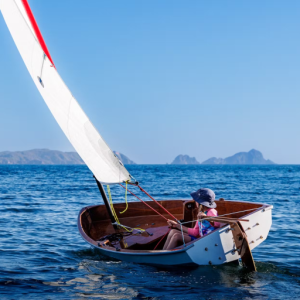
We took the sailing option very seriously for the PT 11 and it’s a good thing we did. Most of the PT 11 builders have chosen our rig and foils. The sailing performance of this boat is not only measured in sailing ability, but also in simplicity and ease of setting up the rig. Setting up and breaking down a sailing rig is always a bit of work, especially if you are doing it alongside a cruising boat. It’s true that the easier the set-up, the more one goes sailing. Our rig is as light and easy to use as possible. The carbon fiber mast is two-piece and sleeves together. The boom carries all of the hardware and running rigging. The gooseneck fitting is made by us. It has no moving parts, installs instantly, and is held to the mast by the sail and vang. High quality snap and “S” hooks make set-up significantly faster.
The sail is small (54 sq. ft.), but it’s a powerhouse, thanks to a good sail designer, Sandy Goodall. The sails are made from DK 160 Challenge.(TM)
The PT 11 sailing rig is sold complete and ready to use.
The rig comes in its own bag shipped in an 8ft long x 7″ x 7″ box.
 In the 94″ bag: carbon mast, boom, running rigging, and 54 ft sq sail. All this weighs barely 11 pounds! Assembled, the mast is 15′ 1″ tall with a 10″ bury. (socket on the PT 11 and Spear dinghies.
 Out haul and main sheet tackle.
Line colors change with various batches.
 Below: Gooseneck and vang The red part is the sleeve on the sail.
 The gooseneck left was our original design that turned out to be quite labor intensive.
We have since developed a machined Delrin gooseneck, (below) glued into the boom rather than riveted and that has been working great. 
 Earlier model above with an S-hook, currently below with a snap-hook.

Having fun!
 UPDATED INFORMATION:
Complete rig: includes a 2-part carbon mast + boom, all associated hardware and running rigging, sail and bag. It is extremely lightweight (barely 11 Lbs) and quick to set up.
Our Spar tubes are custom made in the USA + Harken, Ronstan, & Allen Hardware)
The masts and booms are made in state by ICE, a maker of the highest quality carbon fiber tubes on the planet. The two-part mast and boom (almost 23 lineal feet of tapered custom carbon tubes) weigh just 6.7 lbs and that includes all the hardware and running rigging on the boom (5 blocks, 2 snap hooks, 1 s-hook, 7 eye straps, 1 cleat, 37 feet of running rigging, and a custom gooseneck fitting.
Pricing on the CLC website
We have minimal notes for builders to create their own sailing rig as an alternative, starting with 2 standard diameter 460 windsurfer masts.
About the PT Eleven sail :
A foil shaped, luff sleeved sail with 2 short battens, app 54ftsq. (DK160) Challenge(TM) sail cloth is made in the USA. This type of sail does not reef and we have not missed such a feature. It is a single, relatively small sail well shaped for a variety of conditions. There is no jib or spinnaker.
PT 11 Sails are designed by Sandy Goodall and prototyped by Sean Rankins of NW Sails & Canvas. Production modifications by Bob Pattison of Sails International. *Production by Neil Pryde/Sails International.
Read Sandy’s Review of Sailing the PT 11.
Notes on the design; Look for ‘REEFING THE SAIL?’
In dinghy sailing events placed in the same class as Lasers, we found the PT 11 to be competitive upwind as the foils and sail allow for pointing very high. However; The PT 11 is not designed as a racing dinghy, but it is a very fun boat to sail. AEB
Every time Russell has a boat to build, he seeks better ways of doing things. In this case, a simplified method for gluing the puzzle joints revealed itself. The manual for the PT 11 ‘Spear’ has this section but earlier versions of the PT 11 nesting dinghy manuals have an earlier method. I have created a pdf file of the 7 page replacement for pages 7 through 14 in “Building the PT Eleven” for those who have an older version and have not yet begun to build their boat. This may also be interesting to anyone building a stitch and glue kit with puzzle joints. Click HERE to download the .pdf file. (533kb)
We recently had a rather large run of foils (dagger-boards and rudders) machined that are not quite up to our standards.
They are very slightly less accurate than our our usual nearly perfect foils and on the dagger-boards there is a small depression on the starboard side only.  This low area is visible in the photo and would look a bit odd on a bright finished foil.

We painted the upper end of a dagger-board from this batch to hide the filled low spot and it looks really sharp (see photo). 
SOLD
Click for more detailed information on our foils kits. Also, see our options page for the PT 11.
All of our kit parts, including the foils are cut from the highest quality Lloyds okoume marine plywood. Note that 12mm plywood is now only available in the 7 ply instead of 9ply as shown in earlier foils kits. This means the foils now have 14 plies instead of 18.
Call or email for more information or to order foils. Cheers, 🙂 PTW
A new video has been posted showing the PT Eleven nesting dinghy being towed at 9 and 15 knots. Check it out here: Towing the PT 11
Also, as a heads up, we have yet to update our PT 11 water tight hatch blog. It just got lost in the stack of “to-do’s”. Since our original hatch blog last year, we offer an improved hatch kit with our PT 11 kits. This has recently come to my attention because this outdated blog has been referenced on some forums and I thought, hmmm, we need to fix this… Thus, a new post will soon be up. Coming soon, we will have 2 additional sizes of water tight hatch kits designed with the SCAMP in mind. Thanks to Howard Rice and Josh Colvin of Small Craft Adviser magazine, our hatch design has gained the interest of SCAMP builder’s. A detailed post about this will also follow soon. PTW 🙂