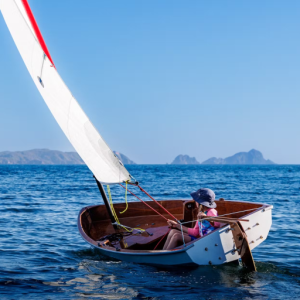
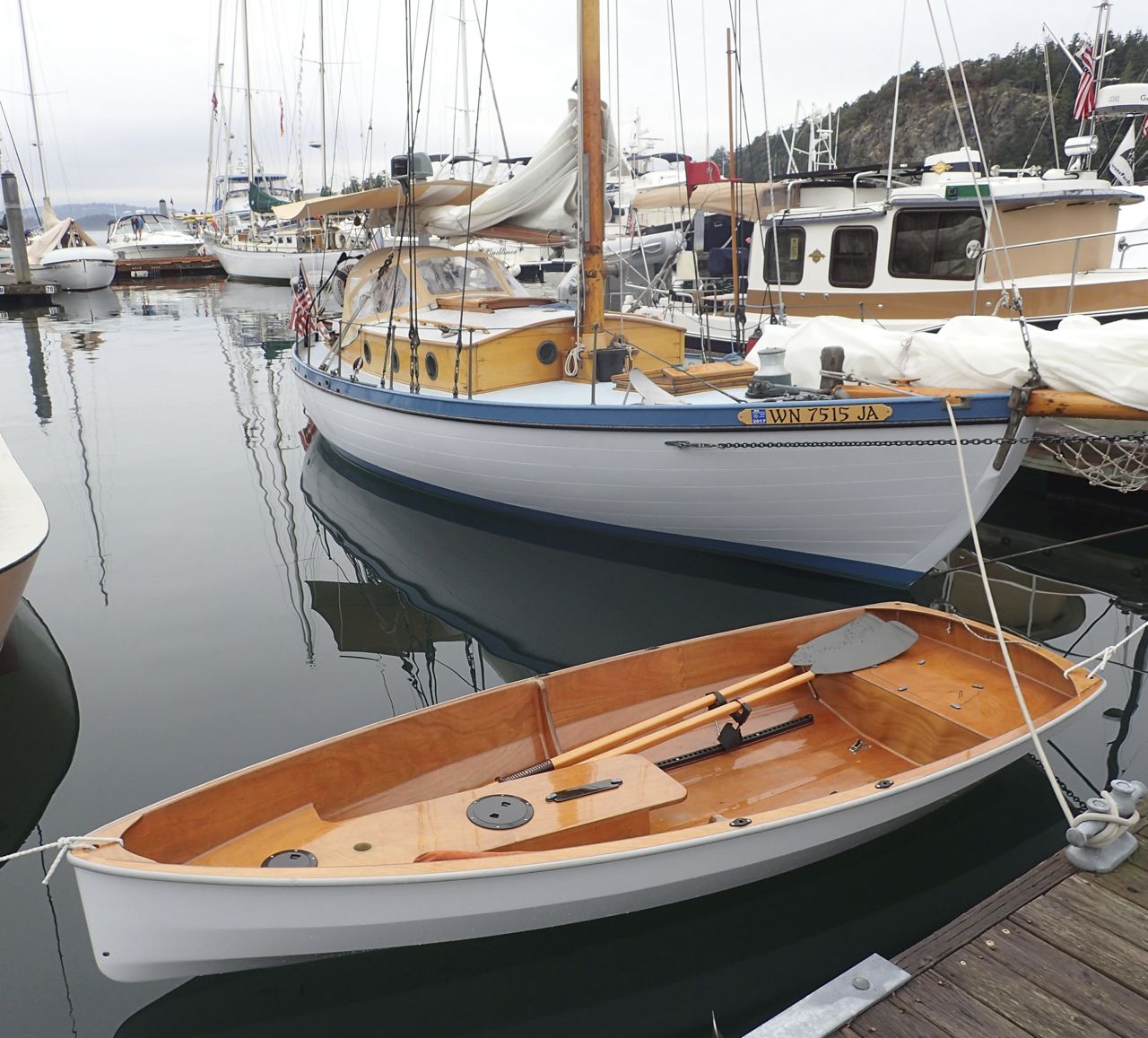
PT Watercraft designs dinghies that are efficient, functional, modern, and attractive—available as kits you can build yourself. We also carry small boat parts and instructional books.
It’s time for us to admit it, our boats seem have a weakness. We may just be treating our boats poorly, but it’s more likely that there is an issue that PT 11 owners should be aware of.
Owners, please check your gunwales for cracks.
Beginning the repair…
Builders, there will soon be an added step in the building manual to prevent the problem. If you haven’t glued your bumper on yet, the fix is easy. This printable PDF informs for both a fix or the added step in the build process.
We have seen this failure three times now. The first, when one of our boats got driven over (just the edge) by a truck. We thought that was unusual punishment, fixed the boat and forgot about it.
The second time was a boat that got beat up by solid water while lashed to a foredeck. We didn’t really know what happened there.
The third time it happened, it was our newest PT 11 (3 years old now) and again we don’t know exactly why, but here is our theory:
When the boat is upside down in the nested position and somebody walks on it (or a bunch of people sit on it), where does that weight go? It goes onto the very ends of the gunwales on the fwd hull half.
photo shows where the load goes, (the aft corners of the forward half).
The failures we have seen have always been in the plywood hull skin (right where you would expect it).
Fixing the break and the weakness that caused the break are both pretty easy and important. The first is done by injecting epoxy into a carefully drilled hole to fix the crack, the second by putting screws (with epoxy) into carefully drilled holes.
I admire those who take on the challenge of building a boat or an airplane. CNC technology on kits has done for creative people, what the GPS did for adventurous people. (Not that they might not be one and the same) Cruising is far more accessible to those without traditional navigational skills, and CNC routering has opened up a whole new avenue to those who want to create something that would otherwise have been beyond their skill level.
Pause on that thought while mentally revisiting a lot of fun sailing….. OK-back to the present.
PT 11 nested in the truck. Photo;Randy KerrKim and Mark get the boat wet for the first time. Photo;Randy Kerr
Our customers come from many walks of life and a wide range of ages and skill levels. However; they never fail to impress me. While Russell can take credit for creating a beautiful design, kit and manual, our customers need the vision, passion, patience, and attention to detail for good results. To add the complexity of documenting their own efforts takes the same qualities and much more. I cannot, for example, count how many tens of thousands of photos Russell had to carefully set up, snap, choose, and edit to get a few hundred for the manual.
Hence, for this post, I would like to point the spotlight on the Kerr Family; Randy, Kim, son Alex, and good friend Mark. Not only did they complete their beautifully built PT 11, “Lil’ Bear” in about 6 weeks, their documentation of the experience resulted in a wonderful
“Lil’ Bear” named in honor of Kim’s great uncle who was on the crew of the Coast Guard cutter “USS Bear” back in the late1800’s. Photo;Randy Kerr
and creative little video. The feedback from Kim and her family has been so meaningful to us and I feel puffed up with pride like a mother hen. With their permission I am sharing some of that feedback and the wonderful present of this video. Randy’s videos are all beautifully created and fun to watch so explore and let them know what you think.
Kim goes for her first sail in her PT 11. Photo;Randy Kerr
From Kim, “It was your PT11 kit that made my dream of having a sailboat come true!!!!! Randy and I can’t quit talking about how grateful we are that you guys put so much heart and thought into such a beautiful and smart kit. She sails and rows like a dream! Highlight of our summer to build and sail that boat! So thankful for you and Russell.”
https://vimeo.com/187076801
Yes, there are some crazy things happening in our country and in the world. I refuse, however, to let that overshadow all of the wonderful things and people that, through shear existence and positive attitudes, are in some way, making this world a better place, cherishing what is good and beautiful. Thank you to the Kerr family and all of our customers for your inspiration. AEB 😉
In August, we launched our “new” cruising boat, downsizing from Jzerro to a trailerable catamaran, unique in that genre, the Gougeon 32. We have managed to get away twice this year, on a shakedown trip to Deer Harbor and a week long trip into the San Juan’s after our local Boat Festival. On this last trip we took the PT 11, mounted on a custom made platform. I managed to miss getting a photo of it nested on its platform so we have to get that later.
Mary H is virtually opposite to the G32
We ‘rendezvous’ed with ‘Vito Dumas’, our frequent sailing buddy, in Shallow Bay, Sucia. It turned into a stormy night but we still got in a good hike and a fun row. I snapped the above shot simply because I was struck by the interesting contrast of vessels. ‘Mary H’ is owned by a lovely couple, Lou and Al, who even offered to serve as a ‘dock’ when our anchor was not cooperating. Lou and Al are lifelong sailors only recently giving up their sailing home of decades, for more comfort without giving up mobility on the water.
Vito leaving Shallow Bay, Sucia
Russell and I do enjoy rowing around and exploring. Having Alex with us in his PT SPEAR, ‘Pato’, makes him our best model. He is both a great sailor and rower and I am ever grateful he has not fired this photographer for being such a pest. I cobbed together a short video of our week.
As the wind picked up the next day, we decided to move around to Ewing Cove.
A short run to the other side of Sucia…
We were able to pull the dinghy onto the platform without taking it apart, for the short runs.
The G32
After a day in Ewing Cove we sailed to Stuart Island into Prevost Harbor. ‘Mary H’ had moved there and Madam Pele, with Ian Andrewes showed up too. Ian was aboard the R2AK 2016 winner, Mad Dog Racing. Al Hughes on ‘Mary H’ was Captain on the 2015 R2AK winner Team Elsie Piddock. It felt like a small world, in a good way.
Vito Dumas and Da Capo in Reid Harbor, San Juans
From Prevost we moved to Reid Harbor. There Alex and I practiced our capsize drills. An effort was made to film all of this but the resulting video is mostly out of focus. A camera glitch…Bummer!
Lil’ B, Pato, and Rascal
Scotty, on ‘Da Capo’ joined us in Reid Harbor. Now we had a PT 11 and 2 PT Spears in the fleet; Lil’ B, Pato, and Rascal.
The next day we all had a good sail to Skull Island. (Orcas Island) There we enjoyed some sailing, rowing and hiking before heading back to Port Townsend. There was an impressive wooden, converted work boat crossing the straights with us. The view was beautiful. Photos follow. Video HERE.
AEB 😉
Click photos for larger view, then back tab to return.
View from the trail near Shallow Bay, Sucia
Rock formations on Sucia Island
Dramatic evening sky over Vito Dumas
A short run to the other side of Sucia…
Shallow draft is nice to have sometimes…
Our temporary heater…
Tidal rips and a good wind..
Vito Dumas and Da Capo in Reid Harbor, San Juans
Scotty taking an evening row at Skull Island
Beaitiful evening and Da Capo
friends and nice anchorages…
Crossing the Straights of Juan De Fuca
wooden converted work boat from Alaska headed for Port Townsend..
In the parking lot a Ferrier Tri lowers its mast one way while the G32 lowers the mast the other way.
This year was the 39th annual Victoria Classic Boat Festival. Among our friends who participated, Alex Spear was there with his beautiful boat, Vito Dumas and her tender, ‘Pato’, a PT SPEAR. ‘Pato’ is in fact the very first PT SPEAR.
In Alex’s words, ‘An esteemed panel of judges, including our local Carol Hasse, selected the PT 11/SPEAR as the “best open sailing vessel in the show”.’
This is a great honor. According to Alex, ‘Pato’ was not independently entered in the show but it garnered so much interest and attention from the judges that they deemed it worthy of mention. Our humble gratitude goes out to the judges.
Vito Dumas and tender, Pato, at the docks in Deer Harbor.
From Victoria, ‘Vito Dumas’, ‘Sir Isaac’, ‘Sparkle’ and other familiar and beautiful wooden boats converged at the Deer Harbor Wooden Boat Rendezvous.
Vito Dumas and ‘Pato’.
Below, Looking back on a rainy Deer Harbor.
Looking back on Deer Harbor as we head back to Port Townsend.
Two weeks have already slipped by since the festival! I am late to express my deeply felt gratitude to everyone who makes the festival happen, (http://nwmaritime.org/) , all who participate, and all who come to talk wooden boats and all things boaty. I realize that is a big blanket statement.
Our booth with WEST SYSTEM EPOXY and 3 PT 11’s on display!
For the past 5 years we have been very fortunate to share a tent with WEST SYSTEM EPOXY. This year Alan Gurski (CEO) and Bruce Niederer were on hand with their comprehensive and unbiased knowledge about epoxy; its uses, history, and the very chemistry of it all. If you want to understand epoxy, pros and cons, these are the guys to talk to.
There were more than a few of our customer boats in the festival. PT 11 nesting dinghies and PT Spear dinghies were to be seen on boats, behind boats, at the docks, and out in the bay.
A PT 11 primly nested on Xanadu’s deck/Pato; T/T Vito DumasA completely painted PT 11 as t/t SKYE. PT SKIFF, MOJO in the back ground.
Two customer PT Skiffs graced the festival as well. Both boats are mind blowingly beautifully built and equally unique interpretations of the kit. High compliments are due to these two builders.
The totally tweezed PT Skiff Mojo, built by Mark Ramsby of Portland OR.Mojo’s Instrument panelMojo parading during the Sunday Sail-by. Note the PT 11 sail in the back…Takin’ Five PT SKIFF built by Steve Merrill.
Steve Merrill wipes the morning dew from his PT SKIFF, Takin’ Five. Steve has been meticulous with his build, taking his time. He says he has been really enjoying it and getting creative especially with his ‘expanding’ driver seat and his self bailing installation.
Unique expanding driver seat.
This seat hinges up, slides forward and ……
Expanded seat. NO PLANS so DON”T ASK!
….expands into a romantic, “side-by-each” joy ride seat. My jaw dropped upon seeing this. But, alas, there are NO PLANS for it so you will have to charge up the brain-waves to create your own if you want one!
The PT 11 out in the bay with an RC sailboat and a classic motor yacht.
Our friend, Cooper Parish, took time off from his high-tech job at Scaled Composites in Mojave, to help us at our booth again this year. We love having him! We want him to keep returning every year so we make sure he gets plenty of sailing time in! In spite of being the smallest boat with the least sail area, Cooper sailed ‘Rascal’, a PT SPEAR, to a 3rd place finish (out of 6) among the Non-T-Bird class in the 26ft and under race.
The PT 11 and CLC’s Pocket Ship.
Of the events in the bay over the weekend, I totally missed getting photos of the Schooner Race. With a piping wind, it was one of the fastest schooner races on record at the festival. It was over before I could get to the beach with the camera. I hear it was eventful! John and Anne Bailey’s recently re-launched , Sir Issac, snuffed the fleet.
The Baileys on Sir Isaac in September 2016.The early morning rowing race at the Festival.Lots of varnish!layers of boats…
The PT Wooden Boat Festival is always a colorful affair. It is an overwhelming weekend for us, exciting, exhausting, and encouraging. Customers often visit us at this time and we see our ‘family’ growing. We are seriously looking forward to holding a casual, PT11 sailing regatta of sorts and I will keep you posted on any development in that direction. Thank you all again. AEB 😉
Yesterday morning began with a tropical downpour that is just as out of character for the PNW as this summer’s 90 degree temperatures. A few days ago the driveway was suddenly littered with crunchy yellow alder leaves. It has hit me hard that summer is coming to an end. For us, it also means that our local Wooden Boat Festival, (the 40th!) is upon us. We will be there! September 9, 10, & 11.
Port Townsend watercraft in the WEST SYSTEM tent on the point near the Wee Nip.
We are pleased to announce that two, customer built PT Skiffs to be at the festival this year!
Mojo at the Wooden Boat Festival
Takin’ Five to be at the 40th Wooden Boat Festival in Port Townsend
Immediately prior to festival, we will be in Deer Harbor (Wooden Boat Rendezvous), and just as promptly after festival, we will set sail northward, incommunicado, for 2 weeks.
We try to go sailing every year after festival and this year is special as it will be our first trip in our ‘new’ boat. We have yet to give it a name and perhaps this first real sail on her will help us decide on a name from our list, many suggested by friends.
If you are curious about our odd but inspired cruising boat, a G-32, the original promo videos can be seen HERE, and Russell’s refit blog HERE.
G32-First day out in Port Townsend. Photo; James Curtis
We will have the PT 11 with us as we travel up to Desolation Sound and back. During that 2 weeks we will aim to get new video, recharge our creative and productive energy banks and be on full power for our busier Biz season; Fall through Spring. Hence, we will be a little difficult to reach by phone and a little slow to respond to emails for the rest of September, but please write and leave messages anyway! We will get back to you and new production favors the early birds. There is also the quick deposit button if you are ready to secure your place in line for kits while we are away.
Lined up for a light winds race around the anchorage..
While I am at it, I want to share a couple of pictures of some dinghy fun from this summer. It is exciting for me to realize that quite a few PT 11’s and PT Spears have been completed locally and regionally (with many more on the way!). We had our first ‘mini regatta’ of friends at Watmough Bay this summer and look forward to having more PT 11 ‘meets’ in the future.I also have this vision of a Wooden Boat Festival here, perhaps the 41st next year, where-in a veritable fleet of PT 11’s and Spears fills the foreground of the sail-by on Sunday afternoon, escorted of course, by several PT Skiffs…. my how our family is growing. Mark it on your calendars if you think you can make it. 😉 AEB
Mid August PT11 and PT Spear buddy sail in Port Townsend Bay. Here, stopped for lunch at the North West Maritime Center.
One of my favorite festival sail-by’s, up close and thick with sails…Early one festival morning…
Since we first started selling kits for the PT 11 we have been continually updating the kit, building process, and the boat to make it better. It’s in our nature to do this and it means the boats get stronger, lighter, easier to build, perform better, etc.
click the photo for a detailed post about our rigs.
A good while back, through friends in the high tech world, we developed a connection with a company called Innovative Composite Engineering, a renown carbon tube company in Washington state. They now make our lightweight booms for the sailing rigs.
The 7 1/2′ booms are incredibly lightweight. The tubes start at 20 ounces each. With the gooseneck, hardware, main sheet & vang tackle, they weigh 40 ounces. No one is likely to get knocked out by one of these booms in a gybe and so far they have been strong enough (remember not to over-do the boom vang).
While the masts we sell have been extremely reliable, we knew they could be lighter. After a year of bugging I.C.E. to come up with a mast for us, we finally got a prototype.
The masts that we have been using are modified windsurfing masts. We have to modify them because they are stepped in a short socket and the loads where the mast comes out of the socket are quite significant and different than the loads applied to a windsurfer mast.
The new masts have extra layers of carbon at the lower end starting just above deck level and ending just above where the boom connects to the mast. These extra layers of laminate mean that we will have to do less work to the lower end to make them strong enough.
How light is the new mast? It’s light! The current two-piece masts weigh 104 ounces (2937 grams); already impressively light. The new mast weighs 69 ounces (1950 grams)!
We stress tested the prototype mast as shown on land (and on the water) using two 180 pound people on the rail and the mast was fine.
Having two people on the rail is strongly discouraged by us because of the twisting loads it puts on the boat, the very high loads at the mast step, and finally the mast.
In other words, what we are really after is a feather weight mast, not a mast that could break the boat.
The weight of the rig is directly related to ease of use. Our theory (and it seems well proven now) is that the easier the sailing rig is to use, the more it will be used. Our rig was already the lightest, easiest to use, and most power-per-pound dinghy sailing rig out there. Now it is significantly lighter.
We will pay quite a bit more for the custom masts, but because they will be less work to finish we will likely be able to keep the complete sailing rig cost the same.
Ashlyn can’t get much mast bend.Russell and James hike out with approx 360 Lbs.
We did a load test on the ground, tying the mast to a building and getting two people hiking out on the rail. This was a little scary, but a very effective way to see if the mast was strong enough. (RB)
Ashlyn’s footnote: Our ballast assistant in these photos is a local luthier. Here he is holding the 15′ 1″ mast up by the tip to see how it sounds as a Didjeridoo.
What sound can it make?
See this silly video to hear….
I had him lower the tip for the video because, in the camera, the green house behind appeared to dominate. I regret this now since it would have looked fine. It was impressive how easy it was to keep it up in the air. (AEB.)
This year we did not have a sailboat in the water so we launched the Waterbug and followed some of the lead boats to Victoria.
I have put together a little video (HERE) of our outing, from the start of the Race in Port Townsend, crossing to Victoria and cheering many of the arriving boats. They trickled in all day. (and in the morning on Friday as we left) The very best way to follow the race is on the r2ak.com website.
Below is a slide show as well. Unfortunately, I had a hard time getting many good pictures with the equipment I had and in the rain. There are some very good photos being posted on Facebook and other places online. See Jan’s Marine Photography on Smugmug.com
Bad Kitty at the start…
Bad Kitty at the start…
R2AK start 2016
R2AK start 2016
Mad Dog Racing
Tritium
Tritium
R2AK start 2016
Turn Point Design midway
Turn Point Design midway
Tritium Midway
Tritium Midway
Tritium Midway
R2AK start 2016
Brandon & Piper Turn Point Design
impolite helicopter
R2AK start 2016
R2AK start 2016
R2AK start 2016
R2AK start 2016
R2AK start 2016
R2AK start 2016
R2AK start 2016
R2AK start 2016
Turn Point Design & Bad Kitty
Team Golden Oldies
R2AK start 2016
R2AK start 2016
Bad Kitty midway
Brandon
Lucas
Piper
Arriving to Victoria…
Tritium arriving…
Team Wabi Sabi
Mad Dog Racing
Alula
I liked the kelp image paired with Hold Fast…
Angus Rowing
Turn Point Design
Fuel efficient Waterbug and fuel hogs in the back ground.
Port Townsend Watercraft will be closed for the first 2 weeks of July.
Other dates when we will be hard to reach will be June 22 thru 25th. We plan to be part of the welcoming committee in Victoria for the Race to Alaska participants. Hope to see you at the pre race Ruckus in Port Townsend (June 22) or in Victoria on the 23rd!
We hope everyone has something beautiful and fun within nature in their lives. Get out on the water, take a hike, lay down in a field of flowers, grow a garden…
As more PT Spears are built, the question of an ideal dolly has been asked. Recently, Russell and I joined friends in Port Townsend for a day of sailing. Our friends both own PT Spears; the one-piece version of the PT 11. Each are transported differently. “Pato” arrived in this truck. This is actually an older photo on a day when we left from the launch ramp.
“Rascal” has its own little trailer.
Rascal has a small trailer
Both PT SPEARs have dollies since their humans often launch by themselves. One uses a kayak cart purchased from our local Pygmy Kayaks. We found that the kick stand on this particular cart was a little tricky to get to and adjust with the dinghy being wider than a kayak.
using a kayak carttipping into the water..
“Rascal‘s” human, being a plumber by trade, created his own sturdy dolly.
PVC pipe with a fixed “kick” stand. Sturdy and always in the right place so no need to access to raise or lower.
Made from PVC plumbing- support stand visible here.eazy-peazygetting ready to splash
I also found while writing this post, that there are thousands of images online for kayak and dinghy dollies. It is important to note that the PT SPEAR, at 85 pounds, is easy to manage with a very simple dolly (like a kayak dolly) compared to most of the more complex dinghy dolly designs shown online. UPDATE: One customer has offered his design and details for a PVC dolly he uses for his PT SPEAR: PDF HERE
getting ready to sail away…The perfect day for a dinghy sail…beach picnic