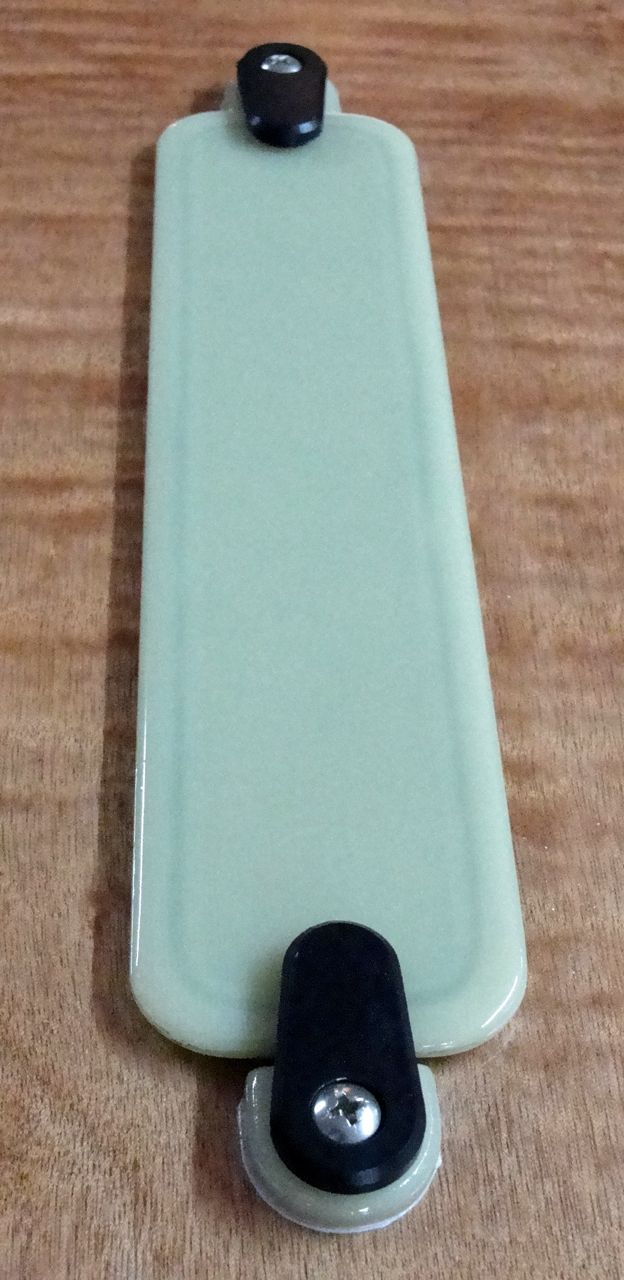
Especially for builders of the PT Eleven, please see this post on the builder's blog. It pertains to the attachment point for the cedar back seat and also to the leather pads. Current versions of the builder's manual does not have this and it should be noted. Cheers,
PTW
A back seat for the PT Eleven
PT 11 Tiller and Hiking stick
Our tiller and hiking stick stock is made of Sapele. The tiller is tapered on 3 sides, shaped at both ends and drilled. The hiking stick has rounded ends, chamfered edges and drilled for attachment. 
The builder finishes the tiller (on the right) by rounding the edges, hand sanding and oiling.
The length of the hiking stick is just right to fit in the corner of the transom of the PT Eleven, for hands free steering when needed. It also folds and stows well. 
Tapering the tiller requires a router jig and so we offer this kit with most of the job done for you. We also offer untapered, 1" tiller stock, for the builder's who wish to shape their own. See the OPTIONS PAGE or the ORDER FORM on our website for prices.
PT Eleven Foil Kits
FOILS (DAGGER BOARD AND RUDDER) KIT
Foils are like wings that operate underwater. As with sails, the shape of the foils directly affects performance. The PT 11 sails amazingly well against the wind, mostly due to good foils.
Dinghy foils are usually either very expensive or they are crude and inefficient. The PT 11 foils are neither, but like the boat itself there are multiple glass & epoxy steps to make them long lasting. One could just epoxy coat them and go sailing, but from our perspective that would be a waste of very high quality plywood and a lot of CNC machine time.
The kick-up rudder design is something we are proud of. The case is fun to build, works very well, and folds for stowing.
Building the case requires multiple epoxy steps and can be done while finishing the foils.
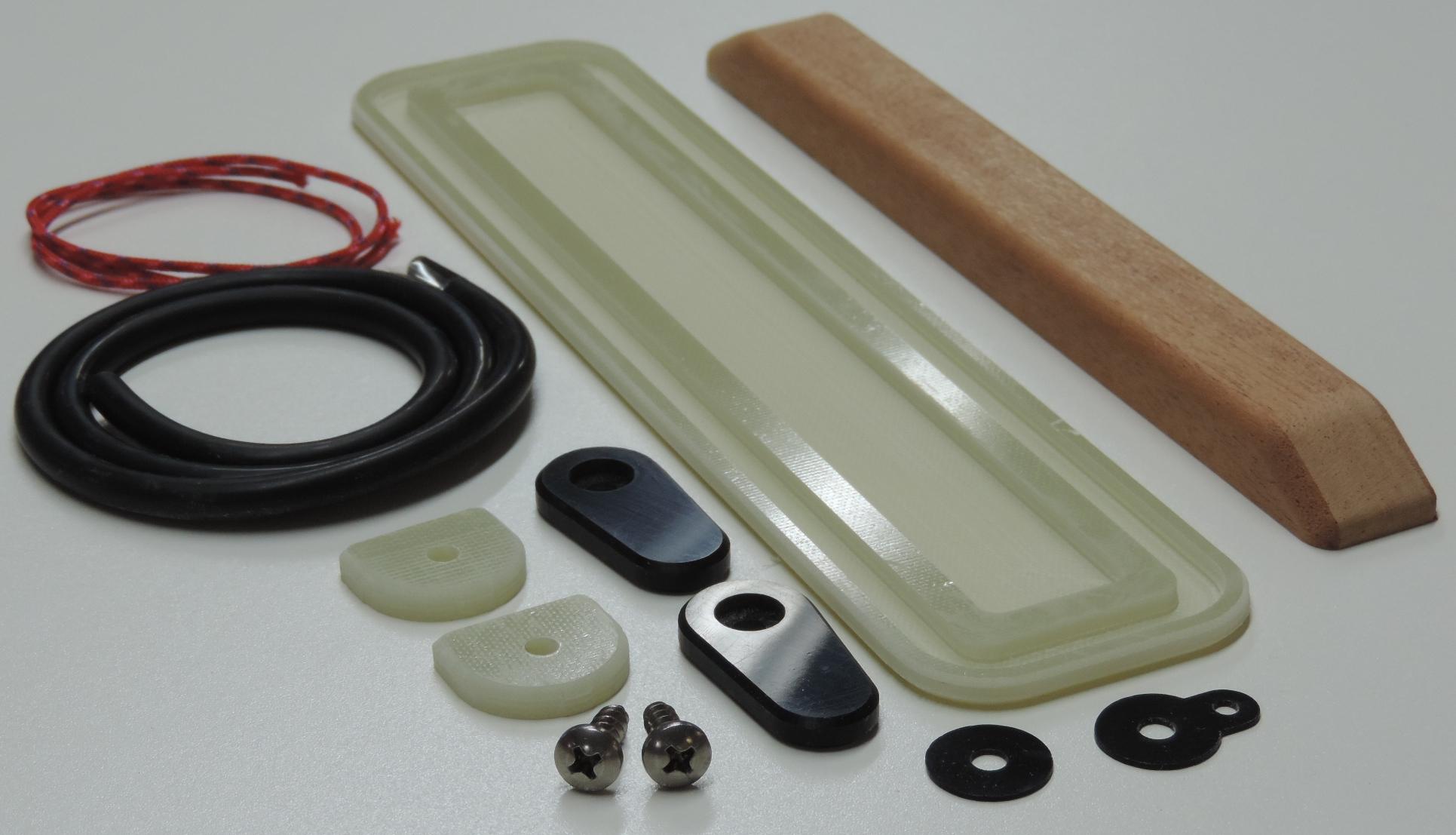
Our foils kit contents are shown in this picture, along with the optional tiller and hiking stick. The foils are a machined NACA .012 section.
A detail of the steering hardware package; Note the scribe marks on the rudder case walls for aligning the pintels.
The rudder and dagger-board are machined in halves from high grade Okoume plywood.
The halves are then glued together and vacuum bagged in our shop before shipping to the builder.
This picture shows the finished foils.
The Rudder folds for easy storage.
See the OPTIONS PAGE on our website for prices.
A row in the PT Eleven nesting dinghy
Thank you Randy, for surprising us with this video, http://www.youtube.com/watch?v=EYMEamd3ME8
Randy's channel also features the Boatschool cutting the PT 11 in half. http://www.youtube.com/watch?v=_7xLYkaX4LA&feature=relmfu
Cheers! PTW
Last Call AUSTRALIA!!
A shipment is headed for Australia and there is still time to get your kit onboard. Shared shipping cost is a benefit to all. The gentleman ordering is offering a super fair deal to share shipping costs, clear the shipment into Adelaide and hold the kit for fowarding or pick up. You can even work with him to pay in AU$..! He has really done the homework and as he really wants his kit, he is offering to do all the hassle for you. Please contact me right away if you want to get a PT Skiff KIT or PT 11 KIT to Australia as they need to be cut in the next week (May 7-11) to make the departure date. This kind of opportunity will not happen often. Cheers!
PTW
Launchings at the NWSWB
Last week the NW School of Wooden Boat Building had a day of launching some of their recently finished boats. It was a casual gathering to which the PT Eleven nesting dinghy was invited. It was good for everyone to see the finished product since they are currently building one of our kits. Lots of people got to go for a row and chat about boats.


PT11 at NW School of Wooden Boat Building
We are please to report that the NW School of Wooden Boat Building is building a PT Eleven nesting dinghy as part of their contemporary boat building program. It is being built in their newly built, on campus facility, the Jeff Hammond building, especially designed to serve as a workshop for larger projects. The boat school students are working the Sliver project; a 62foot, Bob Perry designed super sleek, day sailor. Take note that the first photo is taken with an extremely wide angle lens. The boat in the background really is 62ft long.
The PT Eleven is being built along side the Sliver project. When completed, it will be for sale. If anyone is interested in purchasing a completed PT Eleven, they should contact Bruce Blatchley at the school. (see above NWSWB link) Russell says they are doing a really clean job so far. 


Back to work
Hello All,.. I am back at work after 3 weeks out of the country. I was visiting family and snowed in up in the black mountains of southern France... far from boats...but I also spent time investigating the logistics of making our kits easily available to our European followers. I am a little bit closer to a viable solution. With our limited budget, it all takes real figuring and coordination. One thing that is clear, is that in order to keep shipping costs low, being able to ship at least 2 PT Skiff kits or 5 PT Eleven kits at once reduces the cost for each buyer dramatically. Ocean freight is calculated with a minimum volume so shipping one kit or 5 is nearly the same price. Import duties and clearance fees are being checked into in France and should provide a basic idea for most of Europe. There have been discussions about having kits cut in Europe but we find this to be more complex. It simply is not possible at this stage to have someone in Europe make all of the parts. Besides the fact that our kits have parts cut from 5 different thickness of plywood, there are lumber, carbon, fiberglass, and stainless steel specialty parts. We will avoid any kind of fractured production ideas. Our quality expectation is very high and it will be a good while before we have all the glitches worked out so that someone else could reproduce our kits to our standards.
On another note, we will have a PT Eleven on display at the NW Maritime center symposium happening here in Port Townsend on March 16, 17, & 18th. This cruising theme event has a limited number of tickets available so if you think you would like to attend, follow this link and get more information. The presenters scheduled promise to make this a very interesting weekend. We are nearing completion of the current PT Eleven nesting dinghy, which has been a bit on the back burner. Russell has had other projects demanding his attention. Symposium participants will be able to take it out for a row at various times over the weekend.
We have lots of posts in preparation so we hope you will stay tuned. 

A Bumper for the PT Eleven
A good bumper for the PT 11 has been a priority since the beginning.
We have seen lots of different dinghy bumpers over the years, lots of them falling off or the rails falling off because of all the fasteners used to hold the bumper on.
We know that bumpers on dinghies are a challenge and we have tried different types; the favorite being 3/4” braided nylon rope glued into a notch on the outside of the gunwale. This bumper but was very hard and probably quite heavy when wet, but it lasted over 20 years, and never came un-glued.
The gunwale on the PT11 (as well as the rest of the boat) has to be sealed against moisture intrusion for longevity, so installing a bumper with fasteners is out of the question, unless you are willing to replace the gunwale periodically.
The most highly recommended dinghy bumper is a round closed cell foam covered with a fire hose like canvass material. This is usually attached with hundreds (I’m not kidding) of screws or ring nails, but could be glued on. See following photo.
The challenges with this bumper are:
1.How to finish at the ends. It can’t just be cut as the foam would be exposed and the canvass will fray. Usually the foam is cut short and the canvass folded over and sewn, but in a nesting dinghy this would have to be done at all 4 bumper ends at the joint between the hull halves as well as at the transom and would likely need fasteners at these points.
2. it adds to the overall width of the boat.
3. it would be difficult to install straight and clean and may not look so hot.
4. it would be very heavy when wet. ... Oh, and it’s very expensive..(nearly $10/ft)
All the above is to explain how we arrived at the glue-on extruded rubber bumper.
We originally were planning a C-shaped section that would glue over the outer edge of the gunwale, but it would have to be glued on with something other than a contact adhesive and there would be challenges at the stem, transom, and in fitting around the oarlock riser blocks.
Thus we came to keeping the outer edges of the gunwale square and gluing a custom extruded bumper to the 1” wide flat present on the outer edge.
The bumper shown in the following photos was designed by us for the PT 11 and made by a manufacturer who makes rubber bumpers (chafe guards) for inflatables.
These bumpers are made from non-marking compounds and can be glued on with Hypalon glue, the same glue used to attach this type of rubber to inflatables.
Gluing this bumper on to a PT 11 is a bit of a process. The hypalon glue is two-part, stinky, and must be applied in a dry area. Being a contact adhesive, no clamping pressure is needed, but you only get one chance to put the bumper on straight.
Repairing sections of this bumper would be quite easy and could be done with a one-part contact adhesive.
The die used to make our bumper will be modified slightly and another prototype made before we order the huge quantity necessary for a minimum order.
An instruction booklet will be included with the bumper kits.
PHOTOS

Visit ptwatercraft.com or,
Contact us for more info..